
|
Size: 726
Comment: Initial commit
|
Size: 5008
Comment: Moved geometric note
|
| Deletions are marked like this. | Additions are marked like this. |
| Line 1: | Line 1: |
| = Vector Multiplication = | = Vector Operations = '''Vector operations''' can be expressed numerically or geometrically. |
| Line 9: | Line 11: |
| == Addition == Vectors are added numerically as piecewise summation. Given vectors a⃗ and b⃗ equal to ''[1,2]'' and ''[3,1]'', their sum is ''[4,3]''. Vectors are added geometrically by joining them tip-to-tail, as demonstrated in the below graphic. {{attachment:add.png||height=200px}} === Properties === These two views of vector addition also demonstrate that addition is commutative. Furthermore, it follows that if a⃗ + b⃗ = c⃗, then c⃗ - b⃗ = a⃗. ---- == Scalar Multiplication == Multiplying a vector by a scalar is equivalent to multiplying each component of the vector by the scalar. Geometrically, scalar multiplication is scaling. ---- |
|
| Line 11: | Line 43: |
| The '''dot product''' of two vectors gives a single scalar value. | Vectors of equal dimensions can be multiplied as a '''dot product'''. In calculus this is commonly notated as ''a⃗ ⋅ b⃗'', while in [[LinearAlgebra|linear algebra]] this is usually written out as ''a^T^b''. |
| Line 13: | Line 45: |
| Generally, given two vectors ('''''a''''' and '''''b''''') with ''n'' dimensions, the dot product is computed as: {{attachment:dot1.svg}} Concretely, if '''''a''''' and '''''b''''' have three dimensions (labeled ''x'', ''y'', and ''z''), the dot product can be computed as: {{attachment:dot2.svg}} |
In ''R^3^'' space, the dot product can be calculated numerically as ''a⃗ ⋅ b⃗ = a,,1,,b,,1,, + a,,2,,b,,2,, + a,,3,,b,,3,,''. More generally this is expressed as ''Σa,,i,,b,,i,,''. |
| Line 24: | Line 50: |
| julia> A = [2,3,4] 3-element Vector{Int64}: 2 3 4 julia> B = [5,6,7] 3-element Vector{Int64}: 5 6 7 |
|
| Line 37: | Line 51: |
| julia> A ⋅ B | julia> [2,3,4] ⋅ [5,6,7] |
| Line 40: | Line 54: |
Geometrically, the dot product is ''||a⃗|| ||b⃗|| cos(θ)'' where ''θ'' is the angle formed by the two vectors. This demonstrates that dot products reflect both the [[Calculus/Distance|distance]] of the vectors and their similarity. The operation is also known as a '''scalar product''' because it yields a single scalar. Lastly, in terms of linear algebra, ''a ⋅ b'' is equivalent to multiplying the distance of ''a'' by the [[Calculus/Projection#Scalar_Projection|scalar projection]] of ''b'' into the column space of ''a''. Because a vector is clearly of [[LinearAlgebra/Rank|rank]] 1, this column space is in ''R^1^'' and forms a line. As a result of this interpretation, this operation is ''also'' known as a '''projection product'''. The dot product can be used to extract components of a vector. For example, to extract the X component of a vector a⃗ in ''R^3^'', take the dot product of it by the [[Calculus/UnitVector|unit vector]] ''î''. === Properties === Dot product multiplication is commutative. * ''a⃗ ⋅ b⃗ = b⃗ ⋅ a⃗'' * ''a^T^b = b^T^a'' The ''cos(θ)'' component of the alternative definition provides several useful properties. * The dot product is 0 only when ''a'' and ''b'' are [[Calculus/Orthogonality|orthogonal]]. * The dot product is positive only when ''θ'' is acute. * The dot product is negative only when ''θ'' is obtuse. The linear algebra view corroborates this: when ''a'' and ''b'' are orthogonal, there is no possible projection, so the dot product must be 0. ---- == Inner Product == The '''inner product''' is a generalization of the dot product. Specifically, the dot product is the inner product in Euclidean space. The notation is ''⟨a, b⟩''. ---- == Cross Product == Two vectors in ''R^3^'' space can be multiplied as a '''cross product'''. The notation is ''a⃗ × b⃗'' and it is calculated as the determinant of the two vectors together with a vector of ''[î ĵ k̂]'' (referring to the [[Calculus/UnitVector|unit vectors]]): {{attachment:cross.svg}} Recall that the determinant of a matrix does not change with [[LinearAlgebra/Transposition|transposition]], so this 3 by 3 matrix can be constructed either of columns or rows. The cross product returns a vector that is orthogonal to both a⃗ and b⃗, and reflects how dissimilar the vectors are. Geometrically, the cross product is ''||a⃗|| ||b⃗|| sin(θ) n̂'' where ''θ'' is the angle formed by the two vectors and ''n̂'' is the unit vector normal to the two vectors. === Properties === Cross product multiplication is '''anti-commutative''': ''a⃗ × b⃗ = -b⃗ × a⃗''. ---- == Outer Product == Vectors of any sizes can be multiplied as an '''outer product'''. In calculus this is commonly notated as ''a⃗ ⊗ b⃗'', while in [[LinearAlgebra|linear algebra]] this is usually written out as ''ab^T^''. If ''a'' is a column of size ''m x 1'' and ''b'' is a row of size ''1 x n'', then the outer product is of size ''m x n''. === Properties === * ''a⃗ ⊗ b⃗ = (b⃗ ⊗ a⃗)^T^'' * ''(a⃗ + b⃗) ⊗ c⃗ = (a⃗ ⊗ c⃗) + (b⃗ ⊗ c⃗)'' * ''c⃗ ⊗ (a⃗ + b⃗) = (c⃗ ⊗ a⃗) + (c⃗ ⊗ b⃗)'' * ''d(a⃗ ⊗ b⃗) = (da⃗) ⊗ b⃗ = a⃗ ⊗ (db⃗)'' * ''(a⃗ ⊗ b⃗) ⊗ c⃗ = a⃗ ⊗ (b⃗ ⊗ c⃗)'' Because every column in an outer product is a linear combination of ''a⃗'', there is always multicolinearity. Therefore an outer product is always of [[LinearAlgebra/Rank|rank]] 1. |
Vector Operations
Vector operations can be expressed numerically or geometrically.
Contents
Addition
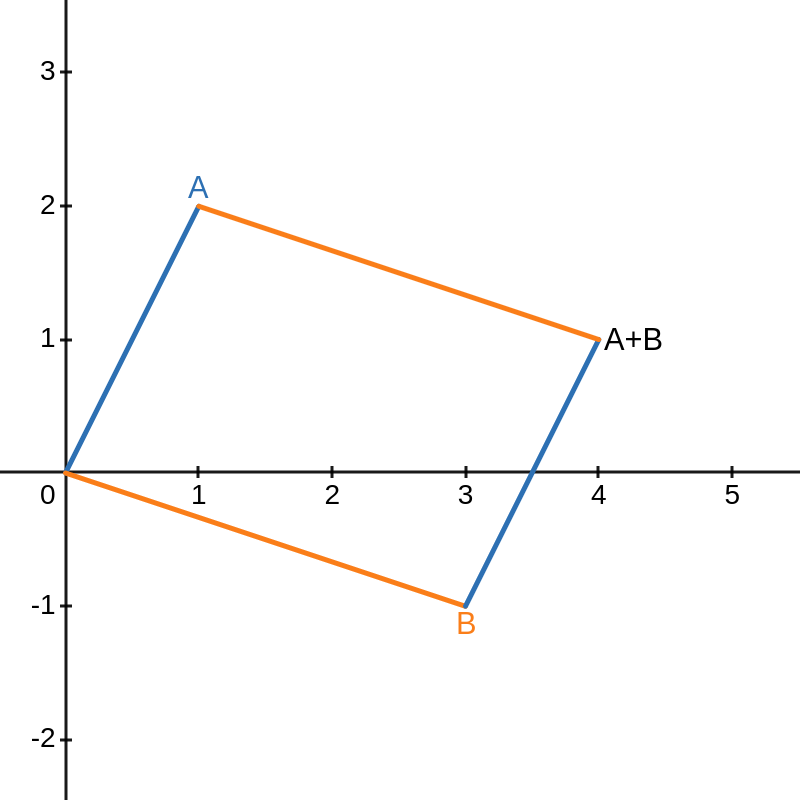
Vectors are added numerically as piecewise summation. Given vectors a⃗ and b⃗ equal to [1,2] and [3,1], their sum is [4,3].
Vectors are added geometrically by joining them tip-to-tail, as demonstrated in the below graphic.
Properties
These two views of vector addition also demonstrate that addition is commutative.
Furthermore, it follows that if a⃗ + b⃗ = c⃗, then c⃗ - b⃗ = a⃗.
Scalar Multiplication
Multiplying a vector by a scalar is equivalent to multiplying each component of the vector by the scalar.
Geometrically, scalar multiplication is scaling.
Dot Product
Vectors of equal dimensions can be multiplied as a dot product. In calculus this is commonly notated as a⃗ ⋅ b⃗, while in linear algebra this is usually written out as aTb.
In R3 space, the dot product can be calculated numerically as a⃗ ⋅ b⃗ = a1b1 + a2b2 + a3b3. More generally this is expressed as Σaibi.
julia> using LinearAlgebra

julia> # type '\cdot' and tab-complete into '⋅'
julia> [2,3,4] ⋅ [5,6,7]
56
Geometrically, the dot product is ||a⃗|| ||b⃗|| cos(θ) where θ is the angle formed by the two vectors. This demonstrates that dot products reflect both the distance of the vectors and their similarity.
The operation is also known as a scalar product because it yields a single scalar.
Lastly, in terms of linear algebra, a ⋅ b is equivalent to multiplying the distance of a by the scalar projection of b into the column space of a. Because a vector is clearly of rank 1, this column space is in R1 and forms a line. As a result of this interpretation, this operation is also known as a projection product.
The dot product can be used to extract components of a vector. For example, to extract the X component of a vector a⃗ in R3, take the dot product of it by the unit vector î.
Properties
Dot product multiplication is commutative.
a⃗ ⋅ b⃗ = b⃗ ⋅ a⃗
aTb = bTa
The cos(θ) component of the alternative definition provides several useful properties.
The dot product is 0 only when a and b are orthogonal.
The dot product is positive only when θ is acute.
The dot product is negative only when θ is obtuse.
The linear algebra view corroborates this: when a and b are orthogonal, there is no possible projection, so the dot product must be 0.
Inner Product
The inner product is a generalization of the dot product. Specifically, the dot product is the inner product in Euclidean space. The notation is ⟨a, b⟩.
Cross Product
Two vectors in R3 space can be multiplied as a cross product. The notation is a⃗ × b⃗ and it is calculated as the determinant of the two vectors together with a vector of [î ĵ k̂] (referring to the unit vectors):

Recall that the determinant of a matrix does not change with transposition, so this 3 by 3 matrix can be constructed either of columns or rows.
The cross product returns a vector that is orthogonal to both a⃗ and b⃗, and reflects how dissimilar the vectors are.
Geometrically, the cross product is ||a⃗|| ||b⃗|| sin(θ) n̂ where θ is the angle formed by the two vectors and n̂ is the unit vector normal to the two vectors.
Properties
Cross product multiplication is anti-commutative: a⃗ × b⃗ = -b⃗ × a⃗.
Outer Product
Vectors of any sizes can be multiplied as an outer product. In calculus this is commonly notated as a⃗ ⊗ b⃗, while in linear algebra this is usually written out as abT. If a is a column of size m x 1 and b is a row of size 1 x n, then the outer product is of size m x n.
Properties
a⃗ ⊗ b⃗ = (b⃗ ⊗ a⃗)T
(a⃗ + b⃗) ⊗ c⃗ = (a⃗ ⊗ c⃗) + (b⃗ ⊗ c⃗)
c⃗ ⊗ (a⃗ + b⃗) = (c⃗ ⊗ a⃗) + (c⃗ ⊗ b⃗)
d(a⃗ ⊗ b⃗) = (da⃗) ⊗ b⃗ = a⃗ ⊗ (db⃗)
(a⃗ ⊗ b⃗) ⊗ c⃗ = a⃗ ⊗ (b⃗ ⊗ c⃗)
Because every column in an outer product is a linear combination of a⃗, there is always multicolinearity. Therefore an outer product is always of rank 1.