
Vector Operations
Vector operations can be expressed numerically or geometrically.
Contents
Addition
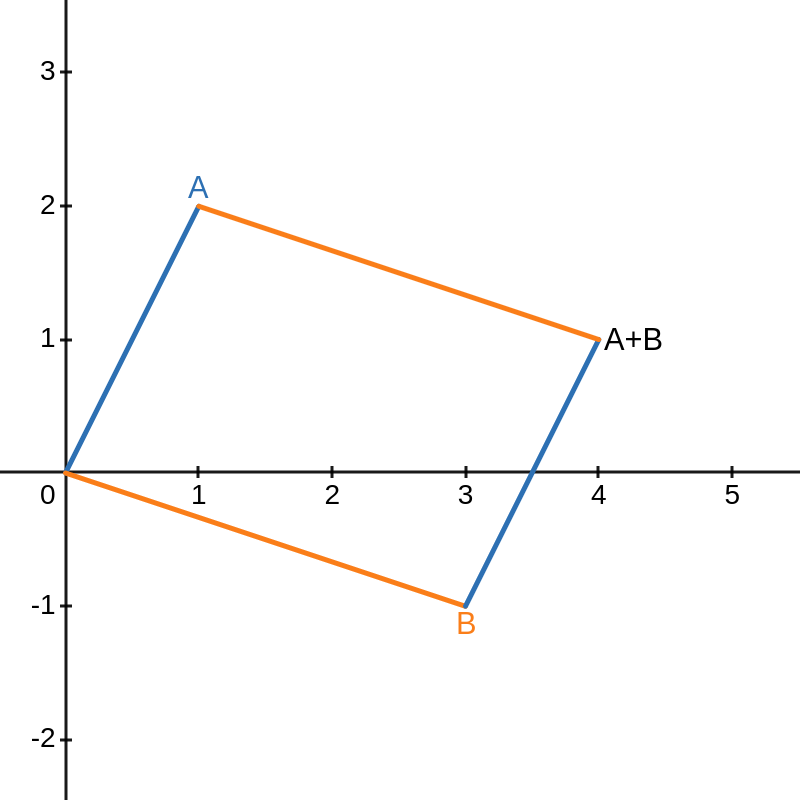
Vectors are added numerically as piecewise summation. Given vectors a⃗ and b⃗ equal to [1,2] and [3,1], their sum is [4,3].
Vectors are added geometrically by joining them tip-to-tail, as demonstrated in the below graphic.
Properties
These two views of vector addition also demonstrate that addition is commutative.
Furthermore, it follows that if a⃗ + b⃗ = c⃗, then c⃗ - b⃗ = a⃗.
Scalar Multiplication
Multiplying a vector by a scalar is equivalent to multiplying each component of the vector by the scalar.
Geometrically, scalar multiplication is scaling.
Dot Product
Vectors of equal dimensions can be multiplied as a dot product. In calculus this is commonly notated as a⃗ ⋅ b⃗, while in linear algebra this is usually written out as aTb.
In R3 space, the dot product can be calculated numerically as a⃗ ⋅ b⃗ = a1b1 + a2b2 + a3b3. More generally this is expressed as Σaibi.
julia> using LinearAlgebra

julia> # type '\cdot' and tab-complete into '⋅'
julia> [2,3,4] ⋅ [5,6,7]
56
Geometrically, the dot product is ||a⃗|| ||b⃗|| cos(θ) where θ is the angle formed by the two vectors. This demonstrates that dot products reflect both the distance of the vectors and their similarity.
The operation is also known as a scalar product because it yields a single scalar.
Lastly, in terms of linear algebra, a ⋅ b is equivalent to multiplying the distance of a by the scalar projection of b into the column space of a. Because a vector is clearly of rank 1, this column space is in R1 and forms a line. As a result of this interpretation, this operation is also known as a projection product.
The dot product can be used to extract components of a vector. For example, to extract the X component of a vector a⃗ in R3, take the dot product of it by the unit vector î.
Properties
Dot product multiplication is commutative.
a⃗ ⋅ b⃗ = b⃗ ⋅ a⃗
aTb = bTa
The cos(θ) component of the alternative definition provides several useful properties.
The dot product is 0 only when a and b are orthogonal.
The dot product is positive only when θ is acute.
The dot product is negative only when θ is obtuse.
The linear algebra view corroborates this: when a and b are orthogonal, there is no possible projection, so the dot product must be 0.
Cross Product
Two vectors in R3 space can be multiplied as a cross product. The notation is a⃗ × b⃗ and it is calculated as the determinant of the two vectors together with a vector of [î ĵ k̂] (referring to the unit vectors):

Recall that the determinant of a matrix does not change with transposition, so this 3 by 3 matrix can be constructed either of columns or rows.
The cross product returns a vector that is orthogonal to both a⃗ and b⃗, and reflects how dissimilar the vectors are.
Geometrically, the cross product is ||a⃗|| ||b⃗|| sin(θ) n̂ where θ is the angle formed by the two vectors and n̂ is the unit vector normal to the two vectors.
Properties
Cross product multiplication is anti-commutative: a⃗ × b⃗ = -b⃗ × a⃗.
Outer Product
Vectors of any sizes can be multiplied as an outer product. In calculus this is commonly notated as a⃗ ⊗ b⃗, while in linear algebra this is usually written out as abT. If a is a column of size m x 1 and b is a row of size 1 x n, then the outer product is of size m x n.
Properties
a⃗ ⊗ b⃗ = (b⃗ ⊗ a⃗)T
(a⃗ + b⃗) ⊗ c⃗ = (a⃗ ⊗ c⃗) + (b⃗ ⊗ c⃗)
c⃗ ⊗ (a⃗ + b⃗) = (c⃗ ⊗ a⃗) + (c⃗ ⊗ b⃗)
d(a⃗ ⊗ b⃗) = (da⃗) ⊗ b⃗ = a⃗ ⊗ (db⃗)
(a⃗ ⊗ b⃗) ⊗ c⃗ = a⃗ ⊗ (b⃗ ⊗ c⃗)
Because every column in an outer product is a linear combination of a⃗, there is always multicolinearity. Therefore an outer product is always of rank 1.