
Random Groups Method
Random groups is a method for variance estimation.
Contents
Description
Given an estimator of the form X̂ = f(Ŷ1, Ŷ2, ... Ŷn) where the Ŷi are themselves estimators, then select k independent samples (i.e., the random groups or replicates) from the set of observations. It is assumed that the expected value of X is constant across each group, E[X̂] = E[X̂alpha] = μ for all alpha.
The group-level estimator is clearly:

The variance of X̂ is then estimated by:

In certain circumstances, it is equivalent to say that:

where
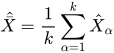
it isn't necessarily obvious that X̂̄ can differ from X̂. Generally the differences derive from f being non-linear. There are contrived examples of non-linear estimators where X̂̄ = X̂ . There are also examples of differences with a linear f, if the estimators are weighted for certain sample designs. Consider a SRSWR design; note that the sample size n is split into k random groups of size m: n = km. It should be clear that the following two estimators differ functionally.
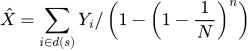

With that said, it should be obvious that E[X̂] = E[X̂̄] = μ.
It can be proven that this alternative estimator is equal to or less than the primary estimator above, so it should never be used wherever a conservative estimator is more appropriate. Furthermore, if the random groups are in fact not independent, then this alternative estimator is biased. Nonetheless, the difference between the two estimators should be extremely small, and the bias in the alternative estimator should become relatively small as the sample size increases.