
Systems of Differential Equations
Systems of differential equations can be solved using linear algebra, specifically the calculation of eigenpairs.
Contents
Formulation
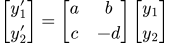
Consider a system of differential equations like:
y'1 = ay1 + by2
y'2 = cy1 - dy2
Reformulate the system as:
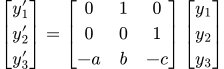
Now consider a higher order differential equation like x''' + ax'' - bx' + cx = 0.
Define a set of substitutions:
y1 = x, so y'1 = x'.
y2 = x', so y'2 = x''.
y3 = x'', so y'3 = x'''.
The original equation is now y'3 + ay3 - by2 + cy1 = 0, or equivalently y'3 = -ay3 + by2 - cy1. Use this along with the substitution definitions for y'1 and y'2 to create the following reformulation:
Solution
The general solution to a single differential equation like y' = ry is y = cert where c is some constant.
The general solution to a system of differential equations like the above is of the form:

where each rn is unique and each cn is a vector matched to a specific rn. Furthermore, each cn is orthogonal to the others. The kn are simply constants reflecting all linear combinations of these independent components.
These pairs of rn and cn are eigenpairs.
Repeated Eigenvalues
If there are repeated eigenvalues, it must be assumed that there is an additional independent solution. Consider a system with two variables. The repeated eigenpair will be notated r and c rather than r1 and c1. The general solution will have the form:
y = k1ertc + k2(tertc + ertd)
where d is another, independent vector that satisfies the equation:
(A - rI)d = c
This is rather like solving for the eigenvector in the first place. Rather than identifying a linear combination that maps (A - rI) to the zero vector, d maps it to eigenvector itself.
Complex Eigenpairs
A complex eigenpair can be refactored using Euler's equation (i.e., eiθ = cosθ + isinθ).
Let the eigenvalue be a + bi; the eigenvector will be left as c. The solution then takes the form y = e(a + bi)tc, but this can be refactored as y = eat ebit c and finally as y = eat (cos(bt) + isin(bt)) c.
By multiplying out the trigonometric functions and c, then factoring out the imaginary components, the solution becomes:
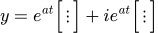
The general solution however is formed by combinations of the independent components. The second component is used as a real vector, rather than an imaginary one.
