
|
Size: 3495
Comment: Cleanup
|
← Revision 12 as of 2026-02-04 02:17:02 ⇥
Size: 3459
Comment: Rewrite
|
| Deletions are marked like this. | Additions are marked like this. |
| Line 29: | Line 29: |
| This '''Gram-Schmidt procedure''' uses linear combinations and does not change the column space of a system that includes both ''A'' and ''B''. Put another way, if ''A'' and ''B'' are a [[LinearAlgebra/Basis|basis]] for some subspace, then ''â'' and ''b̂'' will be a basis for the exact same subspace. But they will be orthonormal, so certain operations will be simpler. | The '''Gram-Schmidt procedure''' does this using linear combinations, so does not change the subspace spanned by ''A'' and ''B''. Put another way, if ''A'' and ''B'' are a [[LinearAlgebra/Basis|basis]] for some subspace, then ''â'' and ''b̂'' will be a basis for the exact same subspace. But they will be orthonormal, so certain operations will be simpler. |
| Line 43: | Line 43: |
| === Extension to Square Matrices === | === QR Decomposition === |
| Line 45: | Line 45: |
| The Gram-Schmidt procedure can be directly applied to the columns of a square matrix. To reiterate, it does not change the column space. | To reiterate, the Gram-Schmidt procedure uses linear combinations. It can therefore be represented with matrices. First, to orthogonalize a column, a combination of all preceding columns is subtracted. Second, to normalize a column, some portion of itself is taken. Therefore, in the matrix representing this procedure... * the numbers on the diagonal are normalizing factors; how much of the same column to take. * the numbers above the diagonal are how much of each preceding column to take away. * the numbers below the diagonal are all zeros. |
| Line 47: | Line 50: |
| Note that the procedure involves linear combinations. First, to orthogonalize a column, a combination of all preceding columns is subtracted. Second, to normalize a column, some portion of itself is taken. Therefore the diagonal will be the normalizing factors, the values above the diagonal will be the components of other columns to subtract, and everything below the diagonal will be zeros. This can be expressed as a matrix, and importantly it will be an upper triangular matrix. | Note furthermore that this is an upper triangular matrix. |
Orthonormalization
Gram-Schmidt orthonormalization is a process for transforming a set of vectors (or a matrix) into orthogonal unit vectors.
Description
To orthonormalize a set of vectors is to...
make them orthogonal to each other, then
normalize them to a unit distance of 1.
Note that orthogonality is a property of two vectors, not one. No process is needed to 'orthogonalize' a single vector.
Process
Solution
Consider two vectors, A and B. They will be made orthogonal to each other and become a and b. Then they will be normalized and become â and b̂.
The Gram-Schmidt procedure does this using linear combinations, so does not change the subspace spanned by A and B. Put another way, if A and B are a basis for some subspace, then â and b̂ will be a basis for the exact same subspace. But they will be orthonormal, so certain operations will be simpler.
First, recall that orthogonality is a property of two vectors, not one. Therefore A needs no transformation to become a.
B is transformed into b by subtracting all components of a from B. Recall that projections capture how much a vector moves in the column space of another vector. It follows that subtracting the projection of a onto B, from B, results in a b that is independent of a.
This is generally notated as b = B - [(a⋅B)/(a⋅a)]a (i.e., in terms of the dot product) or b = B - [(aTB)/(aTa)]a. But it can also be expressed in terms of the inner product: b = B - [⟨a, B⟩/⟨a, a⟩]a.
If there is a third term C, it must be transformed by subtracting all components of a and of b (not B!) from C. That is, c = C - [(aTC)/(aTa)]a - [(bTC)/(bTb)]b or c = C - [⟨a, C⟩/⟨a, a⟩]a - [⟨b, C⟩/⟨b, b⟩]b. And so on.
The final step is to normalize each vector by their own distance, as in â = a/||a||.
QR Decomposition
To reiterate, the Gram-Schmidt procedure uses linear combinations. It can therefore be represented with matrices. First, to orthogonalize a column, a combination of all preceding columns is subtracted. Second, to normalize a column, some portion of itself is taken. Therefore, in the matrix representing this procedure...
- the numbers on the diagonal are normalizing factors; how much of the same column to take.
- the numbers above the diagonal are how much of each preceding column to take away.
- the numbers below the diagonal are all zeros.
Note furthermore that this is an upper triangular matrix.
Following the above notation, where a matrix has columns A, B, and C and the transformed matrix will have columns â, b̂, and ĉ:
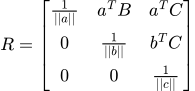
The orthonormalized columns comprise the matrix Q. Because this matrix is orthonormal, it has useful properties like QT = Q-1.
Altogether, this is the QR decomposition and it is expressed as A = QR.