
|
Size: 726
Comment: Initial commit
|
Size: 2415
Comment: Updates
|
| Deletions are marked like this. | Additions are marked like this. |
| Line 1: | Line 1: |
| = Vector Multiplication = | = Vector Operations = '''Vector operations''' can be expressed numerically or geometrically. |
| Line 9: | Line 11: |
| == Addition == ---- == Scalar Multiplication == ---- |
|
| Line 11: | Line 25: |
| The '''dot product''' of two vectors gives a single scalar value. | Two vectors of equal dimensions can be multiplied as a '''dot product'''. The notation is ''a ⋅ b''. It is also known as a '''scalar product''' because the multiplication yields a single scalar. |
| Line 24: | Line 40: |
| julia> A = [2,3,4] 3-element Vector{Int64}: 2 3 4 julia> B = [5,6,7] 3-element Vector{Int64}: 5 6 7 |
|
| Line 37: | Line 41: |
| julia> A ⋅ B | julia> [2,3,4] ⋅ [5,6,7] |
| Line 43: | Line 47: |
| === Properties === Dot product multiplication is commutative. The dot product is 0 only when ''a'' and ''b'' are [[LinearAlgebra/Orthogonality|orthogonal]]. The dot product effectively measures how ''similar'' the vectors are. === Usage === The dot product is also known as the '''projection product'''. The dot product of ''a'' and ''b'' is equivalent to multiplying the distance of ''a'' by the distance of the [[LinearAlgebra/Projections#Vectors|projection]] of ''b'' into ''C(a)'', the column space of ''a''. (Because a vector is clearly of [[LinearAlgebra/Rank|rank]] 1, this space is in ''R^1^'' and forms a line.) Trigonometrically, this is ''||a|| ||b|| cos(θ)''. This provides a geometric intuition for why the dot product is 0 when ''a'' and ''b'' are orthogonal: there is no possible projection, and necessarily multiplying by 0 results in 0. ---- == Inner Product == The '''inner product''' is a generalization of the dot product. Specifically, the dot product is the inner product in Euclidean space. The notation is ''⟨a, b⟩''. ---- == Cross Product == Two vectors of 3-dimensional vectors can be multiplied as a '''cross product'''. The notation is ''a × b''. === Properties === Cross product multiplication is '''anti-commutative''': ''a × b = -b × a''. The cross product effectively measures how ''dissimilar'' the vectors are. === Usage === The cross product is a vector that is orthogonal to both ''a'' and ''b''. |
Vector Operations
Vector operations can be expressed numerically or geometrically.
Contents
Addition
Scalar Multiplication
Dot Product
Two vectors of equal dimensions can be multiplied as a dot product. The notation is a ⋅ b.
It is also known as a scalar product because the multiplication yields a single scalar.
Generally, given two vectors (a and b) with n dimensions, the dot product is computed as:
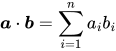
Concretely, if a and b have three dimensions (labeled x, y, and z), the dot product can be computed as:

julia> using LinearAlgebra

julia> # type '\cdot' and tab-complete into '⋅'
julia> [2,3,4] ⋅ [5,6,7]
56
Properties
Dot product multiplication is commutative.
The dot product is 0 only when a and b are orthogonal.
The dot product effectively measures how similar the vectors are.
Usage
The dot product is also known as the projection product. The dot product of a and b is equivalent to multiplying the distance of a by the distance of the projection of b into C(a), the column space of a. (Because a vector is clearly of rank 1, this space is in R1 and forms a line.) Trigonometrically, this is ||a|| ||b|| cos(θ).
This provides a geometric intuition for why the dot product is 0 when a and b are orthogonal: there is no possible projection, and necessarily multiplying by 0 results in 0.
Inner Product
The inner product is a generalization of the dot product. Specifically, the dot product is the inner product in Euclidean space. The notation is ⟨a, b⟩.
Cross Product
Two vectors of 3-dimensional vectors can be multiplied as a cross product. The notation is a × b.
Properties
Cross product multiplication is anti-commutative: a × b = -b × a.
The cross product effectively measures how dissimilar the vectors are.
Usage
The cross product is a vector that is orthogonal to both a and b.