
Circulation Integral
A circulation integral measures rotation.
Description
Circulation of a vector field F along a closed curve C is measured with a line integral.
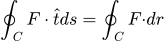
where t̂ is the unit tangent vector. See here for an explanation of dr.
Green's Theorem
When the vector field is given as F = <P(x,y), Q(x,y)>, Green's theorem gives a method for evaluating this.

This can also be easily reformulated into a vector form that uses curl.

where k̂ is the unit basis vector.
Note the closely related normal form of the theorem.
Stoke's Theorem
For a surface S that is bounded by a closed curve C, and given a vector field as F = <P(x,y), Q(x,y)>,, Stoke's theorem gives a method for evaluating this.

where n̂ is the unit normal vector. It should be clear then that Green's theorem is a special case of Stoke's theorem, wherein the vector field is constrained to the xy-plane, and therefore k̂ is always the unit normal vector.
Note that, in some texts, the expression n̂ dS is rewritten as dS or dS⃗. This term represents the differential surface area vector.
An important application of this theorem is that such integrals are surface independent; they depend only on the curve C and the orientation of the surface S. For two surfaces S1 and S2, as long as they have equivalent orientation and both follow C, it must be that:
