
A Comparison of Variance Estimates Using Random Group and Taylor Series Methods for a Large National Survey of Businesses
A Comparison of Variance Estimates Using Random Group and Taylor Series Methods for a Large National Survey of Businesses was written by Sadeq R. Chowdhury and David Kashihara in 2017.
The authors compare the use of random groups and Taylor Series linearized variance estimates with specific application to the Medical Expenditure Panel Survey-Insurance Component (MEPS-IC).
The original (random groups) estimator was:
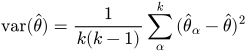
where θ is the estimate using the complete sample and θα is the estimate using random group α.
The linearized estimator, used from 2014 onwards, is:

noting that a FPC was later incorporated as well.
The authors compared the relative standard errors (RSE), i.e. the standard error normalized to the point estimate, of many estimates under both methods. They look for differences in RSEs greater than 2%, greater than 5%, and so on. They find that when there is a discrepancy greater than 5%, the linearized standard errors are smaller.
More broadly, the random groups estimator tends to give a larger standard error when the sample size is small. If estimates are excluded from the analysis wherever the random groups estimator had to use a sample size smaller than 50, the two methods becomes much more similar.