
Finite Population Correction
A finite population correction (FPC) is a multiplicative adjustment used in variance estimation.
Contents
Description
Most formulations of standard errors assume the population is unknown and/or infinite. If the population is finite and the sampling rate is high (above 5%), the standard error is in fact too conservative. Intuitively, there is no uncertainty (i.e., zero variance) to the estimate derived from a census with perfect response.
An adjustment factor is used to correct for this:
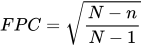
Again, following from the intuitive case, the factor is 0 when n = N because there is no uncertainty given a census with perfect response. Contrarily, the factor approaches 1 as n approaches 0, demonstrating that no correction is required for low sampling rates.
Note that this formula (that is, specifying N-1 in the denominator) is appropriate with samples, which is mostly how FPCs are applied anyway. A denominator of N alone is appropriate for populations. And note that given a sampling fraction f defined as n/N, such an FPC can equivalently be expressed as √(1-f).