
|
Size: 1192
Comment: Math
|
← Revision 5 as of 2026-02-02 17:01:43 ⇥
Size: 2390
Comment: Decomposition
|
| Deletions are marked like this. | Additions are marked like this. |
| Line 33: | Line 33: |
| A rotation matrix is always an [[LinearAlgebra/Orthogonality#Orthonormality|orthogonal matrix]]. It follows that '''''R'''^T^ = '''R'''^-1^''. | A rotation matrix is always [[LinearAlgebra/Orthogonality#Orthonormality|orthonormal]]. It follows that '''''R'''^T^ = '''R'''^-1^''. |
| Line 35: | Line 35: |
| The [[LinearAlgebra/Determinant|determinant]] of a rotation matrix is either 1 or -1. | The [[LinearAlgebra/Determinant|determinant]] of a pure rotation matrix, i.e., one that rotates and does not stretch, is either 1 or -1. === Decomposition of Rotation and Stretching === A 2-dimensional matrix that rotates and stretches can be decomposed between the two components. Consider the example matrix {{attachment:ab.svg}}: * The eigenvalues (''λ'') are ''a + bi'' and ''a - bi'' * Following from the formula for [[Calculus/ComplexVector#Distance|distance of complex vectors]], the stretching factor is ''||λ|| = √(a^2^ + b^2^)''. Therefore the decomposition is: {{attachment:decom.svg}} where: * ''a = ||λ|| cos(θ)'' and ''b = ||λ|| sin(θ)'', or * ''θ = tan^-1^(b/a)'' ---- == Eigenvectors == A matrix that rotates will always have [[Calculus/ComplexVector|complex]] [[LinearAlgebra/EigenvaluesAndEigenvectors|eigenvectors]]. In fact, a complex eigenpair means that the transformation involves rotation. Consider the 2-dimensional case again. There clearly cannot be ''any'' vectors which do not change direction through rotation. Consider now the 3-dimensional rotation matrix for rotation around the Z axis. This is fundamentally the same rotation. But now all vectors along the axis of rotation are unchanged by rotation. |
Rotation Matrix
A rotation matrix represents the linear transformation of rotation.
Contents
Description
A rotation matrix is defined for a specific number of dimensions. In R2, a rotation matrix is:
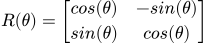
where θ is the angle of counter-clockwise rotation. Note that a negative θ represents clockwise rotation.
As an example, a counter-clockwise rotation of 90 degrees (or π/2 radians) is represented by:
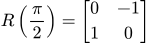
In R3, there are separate rotation matrices for each dimension.

where α, β, and γ represent yaw, pitch, and roll in the Z, Y, and X dimensions respectively. A complete rotation matrix in three dimensions can then be calculated as R = Rz(α)Ry(β)Rx(γ).
Properties
A rotation matrix is always orthonormal. It follows that RT = R-1.
The determinant of a pure rotation matrix, i.e., one that rotates and does not stretch, is either 1 or -1.
Decomposition of Rotation and Stretching
A 2-dimensional matrix that rotates and stretches can be decomposed between the two components.
Consider the example matrix  :
:
The eigenvalues (λ) are a + bi and a - bi
Following from the formula for distance of complex vectors, the stretching factor is ||λ|| = √(a2 + b2).
Therefore the decomposition is:

where:
a = ||λ|| cos(θ) and b = ||λ|| sin(θ), or
θ = tan-1(b/a)
Eigenvectors
A matrix that rotates will always have complex eigenvectors. In fact, a complex eigenpair means that the transformation involves rotation.
Consider the 2-dimensional case again. There clearly cannot be any vectors which do not change direction through rotation.
Consider now the 3-dimensional rotation matrix for rotation around the Z axis. This is fundamentally the same rotation. But now all vectors along the axis of rotation are unchanged by rotation.