
|
Size: 3313
Comment: Remove link
|
← Revision 8 as of 2025-12-10 21:40:02 ⇥
Size: 2081
Comment: Cleanup
|
| Deletions are marked like this. | Additions are marked like this. |
| Line 75: | Line 75: |
| If ''C'' is closed and circular, i.e. there are no endpoints, the integral is notated like | If ''C'' is closed, i.e. there are no endpoints, the integral is notated like: |
| Line 79: | Line 79: |
| and is generally evaluated using '''Green's theorem'''. ---- == Green's Theorem == === Circulation Form === '''Green's theorem''' enables conversion between [[Calculus/Integral|double integrals]] and line integrals along a closed and circular curve ''C''. Consider a [[Calculus/VectorField|vector field]] expressed as ''F = <P(x,y), Q(x,y)>'' and a closed circular curve ''C'' [[Calculus/ParametricEquation|parameterized]] as ''r(t) = <x(t), y(t)>''. The '''circulation form''' of the theorem states that: {{attachment:green1.svg}} for a ''C'' that is oriented counter-clockwise. (For a clockwise oriented ''C'', negate the formula.) In some cases, such an integral is expressed as being along the perimeter of a surface ''D'' rather than along curve ''C''. In this case ''C'' is substituted for ''∂D''. This formulation is particularly useful in cases where derivation eliminates all variables of ''P'' and ''Q'', leaving an integral that is simply the area of region ''D'' (i.e., ''∫∫,,D,, dA'') multiplied by some scalar. This can also be expressed in terms of [[Calculus/Curl|curl]], leading to it sometimes being called the '''curl form'''. {{attachment:green2.svg}} (Note that ''k'' is the [[Calculus/UnitVector|unit vector]].) Note also that there is a [[Calculus/FluxIntegral|normal form]] of the theorem. |
See the [[Calculus/CirculationIntegral|circulation]] and [[Calculus/FluxIntegral#Closed_Line_Integrals|normal forms]] of '''Green's theorem'''. |
Line Integral
A line integral is an integral along a smooth curve C.
Contents
Scalar Line Integral
Given a smooth curve C, integrating a function f along C gives the scalar line integral. As the name implies, this returns a scalar value.

Parameterize f using r(t) for a ≤ t ≤ b to get:
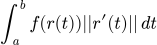
This gives a straightforward calculation for arc length:
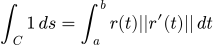
Vector Line Integral
A vector field F is defined for some domain D. Given a smooth curve C that exists entirely within D, the vector line integral is given by:

where T is the unit tangent vector.
Parameterize F using r(t) for a ≤ t ≤ b to get:

dr Reformulation
Another common notation follows from reformulating r'(t) as:


Therefore dr can be substituted into the above equation.

Again parameterize F using r(t) for a ≤ t ≤ b to get:

Conservative Reformulation
If vector field F is conservative, then there exists at least one function f satisfying F = ∇f. If given the start and end points A and B of the curve C, then:
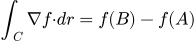
Or parameterize f using r(t) for a ≤ t ≤ b to get:

Circular Integral
If C is closed, i.e. there are no endpoints, the integral is notated like:

See the circulation and normal forms of Green's theorem.