
|
Size: 2216
Comment: Multiple integrals
|
← Revision 6 as of 2026-07-16 14:29:38 ⇥
Size: 2511
Comment: Edit description
|
| Deletions are marked like this. | Additions are marked like this. |
| Line 3: | Line 3: |
| An '''integral''' is the inverse of a [[Calculus/Derivative|derivative]]; an '''antiderivative'''. | An '''integral''' is the generalization of a summation. '''Integration''' is the inverse of [[Calculus/Differential|differentiation]]. Where differentiation relies on calculating [[Calculus/Derivative|derivatives]], integration relies on [[Calculus/Antiderivative|antiderivatives]]. |
| Line 17: | Line 19: |
| Fundamental to solving such integration problems is understanding that integrals are '''antiderivatives'''. Reference [[Calculus/Derivative#Rules|derivative rules]] and apply them in inverse. Concretely, letting ''F'' be the antiderivative of ''f'', and assuming ''f'' is integrable on ''[a,b]'', the above can be solved as: | To solve an integral, calculate the [[Calculus/Antiderivative|antiderivative]] of the function. Concretely, letting ''F'' be the antiderivative of ''f'', and assuming ''f'' is integrable on ''[a,b]'', the above can be solved as: |
| Line 38: | Line 40: |
That is, integrate with respect to one variable while holding the other constant, then integrate with respect to the other. This holds whenever ''f'' is integrable over ''D'' ('''Fubini's theorem'''). |
Integral
An integral is the generalization of a summation.
Integration is the inverse of differentiation. Where differentiation relies on calculating derivatives, integration relies on antiderivatives.
Description
A definite integral represents the area under a curve from a to b. It is notated as:

To solve an integral, calculate the antiderivative of the function. Concretely, letting F be the antiderivative of f, and assuming f is integrable on [a,b], the above can be solved as:

An improper integral sets an infinite bound, like:

Multiple Integrals
When integrating with respect to multiple variables, the order of integration can be swapped. For this reason, a shorthand has emerged:

where D represents a region. This region is then separately expressed with a set notation. For example, consider a region D defined by values of x between a and b and values of y between c and d. The region is expressed as D = {(x,y) | a ≤ x ≤ b, c ≤ y ≤ d}.
The solution to this integral is more clear in the iterated integral form:

That is, integrate with respect to one variable while holding the other constant, then integrate with respect to the other. This holds whenever f is integrable over D (Fubini's theorem).
Indefinite Integrals
An indefinite integral is the generalization of integration, notated as:

Because the derivative of a constant is 0, there are infinitely many antiderivatives for any given function. To represent the generalized set of antiderivatives, add a constant C.
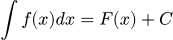
Letting F be the antiderivative of f, an indefinite integral is solved as:
Vector-Valued Functions
The indefinite integral of a vector-valued function is given by:

Letting F, G, and H be the antiderivatives of f, g, and h respectively; and letting C be a vector of Ci, Cj, and Ck, this integral can be expressed as:
