
Antiderivative
An antiderivative is the inverse of a derivative.
Contents
Rules
The basic rules/identities are:
Rule |
Formulation |
Defined for... |
logarithms |
|
|
exponentiation |
|
|
exponentiation with a multiple |
|
|
exponentiation (generalized) |
|
|
polynomials |
|
n != -1 (see the logarithm antiderivative in this case) |
constants |
|
|
constant multiple |
|
|
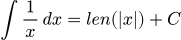
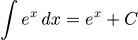
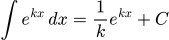


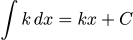

Rule |
Formulation |
Defined for... |
sine |
|
|
cosine |
|
|
secant squared |
|
|



U-Substitution
Given a compound function to integrate, let u be the inner function. The integral can be solved by converting into terms of u and du.
Consider the generalized exponentiation antiderivative rule. Given ∫ef(x)dx to integrate, let u = f(x). The first derivative of u is f ' , so du = f ' dx. By factoring this out of the outer function and substituting it for du, the integral is converted. See the final calculation above.
If solving a definite integral, note that the bounds must also be recalculated as a* = f(a) and b* = f(b).