
|
Size: 2862
Comment: Rule
|
Size: 3046
Comment: Cleanup
|
| Deletions are marked like this. | Additions are marked like this. |
| Line 38: | Line 38: |
| For composite functions like ''f(x) = e^h(x)^'' or ''f(x) = sin(h(x))'', the '''chain rule''' must be applied. Consider the outer function (exponentiation and sine in these examples) to be a function ''g(x)''. It follows that: | For composite functions like ''e^2x^'' or ''sin(2x)'', the '''chain rule''' must be applied. Let ''f'' be the entire function as-is (e.g., ''e^2x^''), ''h'' be the 'inner function (e.g., ''2x''), and ''g'' be the 'outer' function (e.g., ''e^h(x)^''). |
| Line 40: | Line 40: |
| ''f'(x) = g'(h(x)) * h'(x)'' | {{attachment:chain.svg}} |
| Line 46: | Line 46: |
| Consider a function like ''f(x) = g(x)h(x)''. The derivative is evaluated as: | Consider a function like ''f(x) = g(x)h(x)''. Evaluate as: |
| Line 48: | Line 48: |
| {{attachment:prod.svg}} | {{attachment:prod1.svg}} |
| Line 50: | Line 50: |
| This '''product rule''' holds for vector multiplication; that is, for a [[Calculus/VectorOperations#Dot_Product|dot product]]: | This '''product rule''' holds for vector multiplication. That is, given a vector ''f'' that was defined as a [[Calculus/VectorOperations#Dot_Product|dot product]] like ''f = g ⋅ h'', the derivative (i.e., [[Calculus/SpeedVelocityAndAcceleration|over time]]) of ''f'' can be calculated from known derivatives of the components. In this case, try: |
| Line 52: | Line 52: |
| ''f = g ⋅ h'' | {{attachment:prod2.svg}} |
| Line 54: | Line 54: |
| ''df/dx = h ⋅ (dg/dx) + g ⋅ (dh/dx)'' | The same is true of an ''f'' defined as a [[Calculus/VectorOperations#Cross_Product|cross product]] like ''f = g × h''. Try: |
| Line 56: | Line 56: |
| ...and also for a [[Calculus/VectorOperations#Cross_Product|cross product]]: ''f = g × h'' ''df/dx = h × (dg/dx) + g × (dh/dx)'' |
{{attachment:prod3.svg}} |
| Line 66: | Line 62: |
| Consider a function like ''f(x) = g(x)/h(x)''. The derivative is evaluated as: | Consider a function like ''f(x) = g(x)/h(x)''. Evaluate as: |
Derivative
A derivative is an instantaneous rate of change with respect to an input variable. It is a ratio of differentials.
Rules
The basic rules/identities are:
Rule |
Formulation |
Defined for... |
constants |
|
|
constant factors |
|
|
polynomials |
|
|
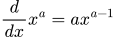
exponentiation |
|
|
exponentiation (generalized) |
|
a > 0 |
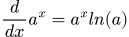
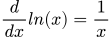
logarithms |
|
x > 0 |
logarithms (generalized) |
|
x > 0 and a > 0 |




Rule |
Formulation |
Defined for... |
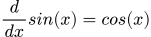
sine |
|
|
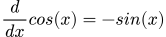
cosine |
|
|
tangent |
|
|
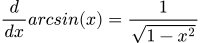
inverse sine |
|
-1 < x < 1 |
inverse cosine |
|
-1 < x < 1 |
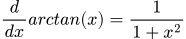
inverse tangent |
|
|


Chain Rule
For composite functions like e2x or sin(2x), the chain rule must be applied. Let f be the entire function as-is (e.g., e2x), h be the 'inner function (e.g., 2x), and g be the 'outer' function (e.g., eh(x)).

Product Rule
Consider a function like f(x) = g(x)h(x). Evaluate as:

This product rule holds for vector multiplication. That is, given a vector f that was defined as a dot product like f = g ⋅ h, the derivative (i.e., over time) of f can be calculated from known derivatives of the components. In this case, try:

The same is true of an f defined as a cross product like f = g × h. Try:

Quotient Rule
Consider a function like f(x) = g(x)/h(x). Evaluate as:

Properties
Derivatives are linear: given a function defined like f(x) = αg(x) + βh(x):
 .
.
The follows from the total differential; substitute g and h for g(x) and h(x):
f = gh
df = fgdg + fhdh
df/dx = fg(dg/dx) + fh(dh/dx)
And clearly the partial derivatives fg and fh are equal to h and g respectively, giving:
df/dx = h(dg/dx) + g(dh/dx)
Substituting back in the original functions gives the product rule.