
|
Size: 647
Comment: Initial commit
|
Size: 2403
Comment: Vectors
|
| Deletions are marked like this. | Additions are marked like this. |
| Line 3: | Line 3: |
| A '''derivative''' is an instantaneous rate of change with respect to an input variable. | A '''derivative''' is an instantaneous rate of change with respect to an input variable. It is a ratio of [[Calculus/Differential|differentials]]. |
| Line 13: | Line 13: |
| {{attachment:const.svg}} | The basic rules/identities are: |
| Line 15: | Line 15: |
| {{attachment:constfact.svg}} | ||'''Rule''' ||'''Formulation''' ||'''Defined for...''' || ||constants ||{{attachment:const.svg}} || || ||constant factors ||{{attachment:constfact.svg}} || || ||polynomials ||{{attachment:polynomial.svg}}|| || ||exponentiation ||{{attachment:e.svg}} || || ||exponentiation (generalized)||{{attachment:exp.svg}} ||''a > 0'' || ||logarithms ||{{attachment:ln.svg}} ||''x > 0'' || ||logarithms (generalized) ||{{attachment:log.svg}} ||''x > 0'' and ''a > 0''|| |
| Line 17: | Line 24: |
| {{attachment:polynomial.svg}} | For [[Calculus/Trigonometry|trigonometric functions]]: |
| Line 19: | Line 26: |
| {{attachment:e.svg}} | ||'''Rule''' ||'''Formulation''' ||'''Defined for...'''|| ||sine ||{{attachment:sin.svg}} || || ||cosine ||{{attachment:cos.svg}} || || ||tangent ||{{attachment:tan.svg}} || || ||inverse sine ||{{attachment:arcsin.svg}}||''-1 < x < 1'' || ||inverse cosine ||{{attachment:arccos.svg}}||''-1 < x < 1'' || ||inverse tangent||{{attachment:arctan.svg}}|| || |
| Line 21: | Line 34: |
| {{attachment:exp.svg}}, for ''a > 0'' | |
| Line 23: | Line 35: |
| {{attachment:ln.svg}}, for ''x > 0'' | |
| Line 25: | Line 36: |
| {{attachment:log.svg}}, for ''x > 0'' and ''a > 0'' | === Properties === |
| Line 27: | Line 38: |
| {{attachment:sin.svg}} | Derivatives are linear: given a function defined like ''f(x) = αg(x) + βh(x)'', {{attachment:sum.svg}}. |
| Line 29: | Line 40: |
| {{attachment:cos.svg}} | The '''product rule''' states that, given a function defined like ''f(x) = g(x)h(x)'', {{attachment:prod.svg}}. This follows from the [[Calculus/Differential|total differential]]; substitute ''g'' and ''h'' for ''g(x)'' and ''h(x)'': |
| Line 31: | Line 42: |
| {{attachment:tan.svg}} | ''f = gh'' |
| Line 33: | Line 44: |
| {{attachment:arcsin.svg}}, for ''-1 < x < 1'' | ''df = f,,g,,dg + f,,h,,dh'' |
| Line 35: | Line 46: |
| {{attachment:arccos.svg}}, for ''-1 < x < 1'' | ''df/dx = f,,g,,(dg/dx) + f,,h,,(dh/dx)'' |
| Line 37: | Line 48: |
| {{attachment:arctan.svg}} | And clearly the partial derivatives ''f,,g,,'' and ''f,,h,,'' are equal to ''h'' and ''g'' respectively, giving: ''df/dx = h(dg/dx) + g(dh/dx)'' Substituting back in the original functions gives the product rule. The product rule holds for vector multiplication; that is, for a [[Calculus/VectorOperations#Dot_Product|dot product]]: ''f = g ⋅ h'' ''df/dx = h ⋅ (dg/dx) + g ⋅ (dh/dx)'' ...and also for a [[Calculus/VectorOperations#Cross_Product|cross product]]: ''f = g × h'' ''df/dx = h × (dg/dx) + g × (dh/dx)'' |
Derivative
A derivative is an instantaneous rate of change with respect to an input variable. It is a ratio of differentials.
Contents
Rules
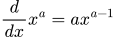
The basic rules/identities are:
Rule |
Formulation |
Defined for... |
constants |
|
|
constant factors |
|
|
polynomials |
|
|
exponentiation |
|
|
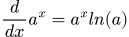
exponentiation (generalized) |
|
a > 0 |
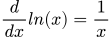
logarithms |
|
x > 0 |
logarithms (generalized) |
|
x > 0 and a > 0 |




Rule |
Formulation |
Defined for... |
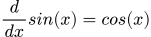
sine |
|
|
cosine |
|
|
tangent |
|
|
inverse sine |
|
-1 < x < 1 |
inverse cosine |
|
-1 < x < 1 |
inverse tangent |
|
|
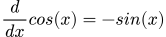

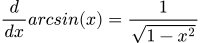

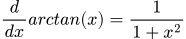
Properties
Derivatives are linear: given a function defined like f(x) = αg(x) + βh(x),  .
.
The product rule states that, given a function defined like f(x) = g(x)h(x), ![[ATTACH]](/Calculus/Derivative?action=AttachFile&do=upload_form&target=prod.svg&ticket=006a99ef3e.48f4c55b1991ec016dc774133ad6667b5ba9710c "[ATTACH]") . This follows from the total differential; substitute g and h for g(x) and h(x):
. This follows from the total differential; substitute g and h for g(x) and h(x):
f = gh
df = fgdg + fhdh
df/dx = fg(dg/dx) + fh(dh/dx)
And clearly the partial derivatives fg and fh are equal to h and g respectively, giving:
df/dx = h(dg/dx) + g(dh/dx)
Substituting back in the original functions gives the product rule.
The product rule holds for vector multiplication; that is, for a dot product:
f = g ⋅ h
df/dx = h ⋅ (dg/dx) + g ⋅ (dh/dx)
...and also for a cross product:
f = g × h
df/dx = h × (dg/dx) + g × (dh/dx)