
|
⇤ ← Revision 1 as of 2026-07-16 14:23:30
Size: 1117
Comment: Initial commit
|
← Revision 2 as of 2026-07-16 14:38:29 ⇥
Size: 1732
Comment: Note
|
| Deletions are marked like this. | Additions are marked like this. |
| Line 33: | Line 33: |
| === U-Substitution === Given a compound function to integrate, let ''u'' be the inner function. The integral can be solved by converting into terms of ''u'' and ''du''. Consider the generalized exponentiation antiderivative rule. Given ''∫e^f(x)^dx'' to integrate, let ''u = f(x)''. The first derivative of ''u'' is ''f ' '', so ''du = f ' dx''. By factoring this out of the outer function and substituting it for ''du'', the integral is converted. See the final calculation above. If solving a definite integral, note that the bounds must also be recalculated as ''a* = f(a)'' and ''b* = f(b)''. |
Antiderivative
An antiderivative is the inverse of a derivative.
Contents
Rules
The basic rules/identities are:
Rule |
Formulation |
Defined for... |
logarithms |
|
|
exponentiation |
|
|
exponentiation with a multiple |
|
|
exponentiation (generalized) |
|
|
polynomials |
|
n != -1 (see the logarithm antiderivative in this case) |
constants |
|
|
constant multiple |
|
|
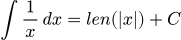
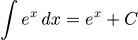
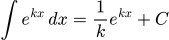


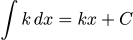

Rule |
Formulation |
Defined for... |
sine |
|
|
cosine |
|
|
secant squared |
|
|



U-Substitution
Given a compound function to integrate, let u be the inner function. The integral can be solved by converting into terms of u and du.
Consider the generalized exponentiation antiderivative rule. Given ∫ef(x)dx to integrate, let u = f(x). The first derivative of u is f ' , so du = f ' dx. By factoring this out of the outer function and substituting it for du, the integral is converted. See the final calculation above.
If solving a definite integral, note that the bounds must also be recalculated as a* = f(a) and b* = f(b).