
|
Size: 2430
Comment: Simplifications
|
← Revision 20 as of 2026-08-09 18:48:19 ⇥
Size: 1846
Comment: Note
|
| Deletions are marked like this. | Additions are marked like this. |
| Line 1: | Line 1: |
| = σ Algebra Notation = | = σ Algebra = |
| Line 3: | Line 3: |
| A '''σ algebra''' (sigma algebra) is a set of measurable sets. | |
| Line 4: | Line 5: |
== Sets and Subsets == The maximal set, which in probability applications is the '''sample space''', is notated as ''Ω''. The sample space could be a discrete set, like ''Ω = {heads, tails}''. It could be a set of discrete numbers, like ''Ω = '''N''''' (all real numbers). It could be a continuous range, like ''Ω = [0,1]''. === Subsets === Subsets are usually named with calligraphic uppercase letters, but that's not exactly practical in typed notes. Capital letters will be used instead. A subset of ''Ω'' is expressed as ''A ⊆ Ω''. === Power sets === The power set of a set (''P(Ω)'') is the set of all subsets, including the empty set (''∅'') and the set itself (''Ω''). This becomes analagous to a probability function in descrete cases. === Intersections and Unions === The '''intersection''' of two sets is notated as ''A ⋂ B''; the '''union''' of two sets is notated as ''A ⋃ B''. The intersection of all subsets ''A,,i,,'' can be expressed as: {{attachment:intersection.svg}} The union of all subsets ''A,,i,,'' can be expressed as: {{attachment:union.svg}} A pair of sets are '''disjoint''' if there is no intersection, which is expressed as ''A ⋂ B = ∅'' === Complements === The '''complement''' of a subset ''A'' is notated as ''A^c^''. |
<<TableOfContents>> |
| Line 53: | Line 11: |
| == Sigma Algebras == | == Description == |
| Line 55: | Line 13: |
| A '''σ algebra''' is usually named with calligraphic uppercase letters, but that's not exactly practical in typed notes. Capital letters will be used instead. | A σ algebra is usually notated using a calligraphic uppercase letters, like 𝒜. |
| Line 57: | Line 15: |
| A σ algebra is notated as ''A ⊆ P(Ω)''. In other words, ''A'' is a subset of the power set of ''Ω''. | For a given sample space ''Ω'', a σ algebra 𝒜 can be defined. It is the [[Analysis/Sets|subset]] of the [[Analysis/PowerSet|power set]] of the sample space (𝒜 ''⊆ P(Ω)'') that satisfies three conditions: |
| Line 59: | Line 17: |
| To qualify as a σ algebra, ''A'' also needs to satisfy three properties: | * Both the empty set and the full sample space are in the σ algebra; ''Ø, Ω ∈'' 𝒜 * The sigma algebra is closed on complementation; ''A ∈'' 𝒜 ''-> A^C^ ∈'' 𝒜 * The sigma algebra is closed upon [[Analysis/Cardinality|countable]] unions; ''⋃ A,,i,, ∈'' 𝒜 where members of 𝒜 be indexed as ''A,,i,,'', ''i ∈ N'' |
| Line 61: | Line 21: |
| * ''Ω'' is in ''A'' * ''A'' is closed upon complementation. For any subset, the complement of that subset is also in ''A''. * ''A'' is closed upon countable unions. ---- |
The smallest possible σ algebra is given by condition 1 literally: ''{Ø, Ω}''. The largest possible σ algebra is of course ''P(Ω)'' itself. All possible σ algebra are bounded by these two extrema. |
| Line 71: | Line 25: |
| == Maps == | === Properties === |
| Line 73: | Line 27: |
| '''Maps''' are usually named with blackboard bold letters, but that's not exactly practical in typed notes. Bold capital letters will be used instead. | For a given sample space ''Ω'', and some number of σ algebras 𝒜'',,i,,'' defined on it, ''⋂,,i,,'' 𝒜 '',,i,,'' is also a σ algebra. |
| Line 75: | Line 29: |
| A map translates a (sub)set into a real number: '''''M''': A -> '''R'''''. | It follows that for any ℳ ''⊆ P(Ω)'', the smallest possible σ algebra that contains ℳ (or the σ algebra generated by ℳ) is given by the intersection of every 𝒜 larger than ℳ. This operation is notated as: {{attachment:gen.svg}} |
| Line 79: | Line 35: |
| === Probability Measures === | === Relation to Borel Sets === |
| Line 81: | Line 37: |
| '''Probability measures''' are the primary use of maps with σ algebras. | The '''Borel set''' (or Borel σ algebra) defined on ''Ω'' is the smallest possible σ algebra generated by the [[Analysis/TopologicalSpace|topology]] of ''Ω''. It follows that: |
| Line 83: | Line 39: |
| A parallel to the functional expression of probability, ''p(A)'', is '''''P''': A -> [0,1]''. | {{attachment:borel.svg}} The Borel set is equal to the power set only when ''Ω'' is discrete and countable. Otherwise, the Borel set is always a subset of the power set. |
σ Algebra
A σ algebra (sigma algebra) is a set of measurable sets.
Description
A σ algebra is usually notated using a calligraphic uppercase letters, like 𝒜.
For a given sample space Ω, a σ algebra 𝒜 can be defined. It is the subset of the power set of the sample space (𝒜 ⊆ P(Ω)) that satisfies three conditions:
Both the empty set and the full sample space are in the σ algebra; Ø, Ω ∈ 𝒜
The sigma algebra is closed on complementation; A ∈ 𝒜 -> AC ∈ 𝒜
The sigma algebra is closed upon countable unions; ⋃ Ai ∈ 𝒜 where members of 𝒜 be indexed as Ai, i ∈ N
The smallest possible σ algebra is given by condition 1 literally: {Ø, Ω}. The largest possible σ algebra is of course P(Ω) itself. All possible σ algebra are bounded by these two extrema.
Properties
For a given sample space Ω, and some number of σ algebras 𝒜i defined on it, ⋂i 𝒜 i is also a σ algebra.
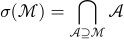
It follows that for any ℳ ⊆ P(Ω), the smallest possible σ algebra that contains ℳ (or the σ algebra generated by ℳ) is given by the intersection of every 𝒜 larger than ℳ. This operation is notated as:
Relation to Borel Sets
The Borel set (or Borel σ algebra) defined on Ω is the smallest possible σ algebra generated by the topology of Ω. It follows that:

The Borel set is equal to the power set only when Ω is discrete and countable. Otherwise, the Borel set is always a subset of the power set.