
σ Algebra
A σ algebra (sigma algebra) is a set of measurable sets.
Description
A σ algebra is usually notated using a calligraphic uppercase letters, like 𝒜.
For a given sample space Ω, a σ algebra 𝒜 can be defined. It is the subset of the power set of the sample space (𝒜 ⊆ P(Ω)) that satisfies three conditions:
Both the empty set and the full sample space are in the σ algebra; Ø, Ω ∈ 𝒜
The sigma algebra is closed on complementation; A ∈ 𝒜 -> AC ∈ 𝒜
The sigma algebra is closed upon countable unions; ⋃ Ai ∈ 𝒜 where members of 𝒜 be indexed as Ai, i ∈ N
The smallest possible σ algebra is given by condition 1 literally: {Ø, Ω}. The largest possible σ algebra is of course P(Ω) itself. All possible σ algebra are bounded by these two extrema.
Properties
For a given sample space Ω, and some number of σ algebras 𝒜i defined on it, ⋂i 𝒜 i is also a σ algebra.
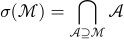
It follows that for any ℳ ⊆ P(Ω), the smallest possible σ algebra that contains ℳ (or the σ algebra generated by ℳ) is given by the intersection of every 𝒜 larger than ℳ. This operation is notated as:
Relation to Borel Sets
The Borel set (or Borel σ algebra) defined on Ω is the smallest possible σ algebra generated by the topology of Ω. It follows that:

The Borel set is equal to the power set only when Ω is discrete and countable. Otherwise, the Borel set is always a subset of the power set.