
|
Size: 2058
Comment: Moving axioms
|
Size: 3396
Comment: Initial commit, needs typesetting
|
| Deletions are marked like this. | Additions are marked like this. |
| Line 30: | Line 30: |
| ---- == Theorems and Properties of Probability == Many important properties of the probability measure derive from the properties of [[Analysis/Sets|sets]]. For example * ''Prob(A^C^ ⋂ B^C^) = Prob((A ⋃ B``)^C^)'' * ''Prob(A ⋂ (B ⋃ C)) = Prob((A ⋂ B``) ⋃ (A ⋂ C))'' Others take advantage of the definition of the probability measure. * ''Prob(Omega)) = 1'' so ''Prob(A) = 1 - Prob(A^C^)'' * ''A ⊆ B'' implies ''Prob(A) ≤ Prob(B``)'' The probability of a union of disjoint sets is simply the sum of their individual probabilities. * ''Prob(A ⋃ B``) = Prob(A) + Prob(B``)'' for any ''A,B'' such that ''A ⋂ B = Ø'' More generally, the probability of a union of 2 events is * ''Prob(A ⋃ B``) = Prob(A) + Prob(B``) - Prob(A ⋂ B``)'' And the probability of a union of 3 events is * ''Prob(A ⋃ B ⋃ C) = Prob(A) + Prob(B``) + Prob(C) - Prob(A ⋂ B``) - Prob(B ⋂ C) - Prob(A ⋂ C) + Prob(A ⋂ B ⋂ C)'' This generalizes to n events as * \sum \nolimits_i Prob( A_i ) - sum \nolimits_{j<i}^n Prob( A_i \cap A_j ) + \sum \nolimits_{k<j<i}^n Prob( A_i \cap A_j \cap A_k ) - \dots + (-1)^{n+1} Prob( \bigcap_{m=1}^n A_m) Several useful identities derive from [[Analysis/BayesTheorem|Bayes' theorem]], like: * ''Prob(A ⋂ B``) = Prob(A) Prob(B|A)'' |
Probability Space
A probability space is a measure space equipped with probability measure.
Description
A probability space is a triple (Ω, ℱ, P), composed of:
a sample space Ω
an event space ℱ, noting this is a σ algebra
a probability measure P : ℱ -> [0,1] satisfying three conditions called the Kolmogorov axioms
A closely related concept is a random variable, which itself is just a map between a sample space and some measurable space (Ω, 𝒜): X : Ω -> 𝒜. When the sample space Ω is common to both the random variable and a probability space, it is possible to lift the probability measure P from the latter into the former. This pushforward measure is a probability distribution. The probability that the random variable X takes on the value x ∈ 𝒜 is given by P(X = x) = P({ω ∈ Ω | X(ω) = x}). The probability that the random variable takes on any value in the subset S ⊆ 𝒜 is given by P(X ∈ S) = P({ω ∈ Ω | X(ω) ∈ S}).
(It may be more appropriate to say that the random variable maps to a topological space. Practically speaking, probability is applied in two ways: the sample space is countable and discrete, or the sample space is uncountable but the random variable maps to real numbers. In either case, the Borel set of Ω is the smallest possible σ algebra that can be defined on Ω.)
In the case of a discrete random variable X, f is called a probability mass function and the final condition above is expressed as:
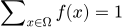
In the case of a continuous random variable X, f is called a probability density function and the final condition above is expressed as:
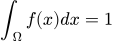
Theorems and Properties of Probability
Many important properties of the probability measure derive from the properties of sets. For example
Prob(AC ⋂ BC) = Prob((A ⋃ B)C)
Prob(A ⋂ (B ⋃ C)) = Prob((A ⋂ B) ⋃ (A ⋂ C))
Others take advantage of the definition of the probability measure.
Prob(Omega)) = 1 so Prob(A) = 1 - Prob(AC)
A ⊆ B implies Prob(A) ≤ Prob(B)
The probability of a union of disjoint sets is simply the sum of their individual probabilities.
Prob(A ⋃ B) = Prob(A) + Prob(B) for any A,B such that A ⋂ B = Ø
More generally, the probability of a union of 2 events is
Prob(A ⋃ B) = Prob(A) + Prob(B) - Prob(A ⋂ B)
And the probability of a union of 3 events is
Prob(A ⋃ B ⋃ C) = Prob(A) + Prob(B) + Prob(C) - Prob(A ⋂ B) - Prob(B ⋂ C) - Prob(A ⋂ C) + Prob(A ⋂ B ⋂ C)
This generalizes to n events as
\sum \nolimits_i Prob( A_i ) - sum \nolimits_{j<i}n Prob( A_i \cap A_j ) + \sum \nolimits_{k<j<i}n Prob( A_i \cap A_j \cap A_k ) - \dots + (-1){n+1} Prob( \bigcap_{m=1}n A_m)
Several useful identities derive from Bayes' theorem, like:
Prob(A ⋂ B) = Prob(A) Prob(B|A)