|
Size: 2084
Comment: Notes
|
Size: 2236
Comment: Update
|
| Deletions are marked like this. | Additions are marked like this. |
| Line 26: | Line 26: |
| (It may be more appropriate to say that the random variable maps to a [[Analysis/TopologicalSpace|topological space]]. There's no practical difference between a topological space ''(Ω, ''ℬ'')'' and a measurable space ''(Ω, ''𝒜'')'' so long as 𝒜 is the [[Analysis/SigmaAlgebra|Borel set]] of ''Ω''.) | (It may be more appropriate to say that the random variable maps to a [[Analysis/TopologicalSpace|topological space]]. Practically speaking, probability is applied in two ways: the sample space is countable and discrete, or the sample space is uncountable but the random variable maps to real numbers. In either case, the [[Analysis/SigmaAlgebra|Borel set]] of ''Ω'' is the smallest possible [[Analysis/SigmaAlgebra|σ algebra]] that can be defined on ''Ω''.) |
Probability Space
A probability space is a measure space equipped with probability measure.
Contents
Description
A probability space is a triple (Ω, ℱ, P), composed of:
a sample space Ω
an event space ℱ, noting this is a σ algebra
a probability measure P : ℱ -> [0,1]
As for a probability measure, this is a map from ℱ to real numbers between 0 and 1. It must satisfy three conditions:
P(Ø) = 0
- additivity
see measure spaces for details
P(ℱ) = 1
A closely related concept is a random variable, which itself is just a map between a sample space and some measurable space (Ω, 𝒜): X : Ω -> 𝒜. When the sample space Ω is common to both the random variable and a probability space, it is possible to lift the probability measure P from the latter into the former. This pushforward measure is a probability distribution. The probability that the random variable X takes on the value x ∈ 𝒜 is given by P(X = x) = P({ω ∈ Ω | X(ω) = x}). The probability that the random variable takes on any value in the subset S ⊆ 𝒜 is given by P(X ∈ S) = P({ω ∈ Ω | X(ω) ∈ S}).
(It may be more appropriate to say that the random variable maps to a topological space. Practically speaking, probability is applied in two ways: the sample space is countable and discrete, or the sample space is uncountable but the random variable maps to real numbers. In either case, the Borel set of Ω is the smallest possible σ algebra that can be defined on Ω.)
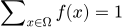
In the case of a discrete random variable X, f is called a probability mass function and the final condition above is expressed as:
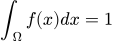
In the case of a continuous random variable X, f is called a probability density function and the final condition above is expressed as: