
Power Series Distribution
The power series distribution is a probability mass function derived from a power series.
Description
Recall that a power series is the sum over n of the sequence anxn. Assuming this converges, it is possible to normalize the sequence (i.e., divide by the convergent sum) such that the series equals one, satisfying the conditions of a probability distribution.
For discrete random variables, many probability distribution functions are fundamentally special cases of a power sequence. While the overall series is clearly in the denominator, the numerator is a single term of the sequence.
Quickly note that most of the notation is swapped out. x conventionally refers to a specific value taken on by random variable X, so clearly it takes the place of n in the series notation. x in the series notation meanwhile becomes a fixed parameter θ. Lastly the coefficient is commonly written as a function of x (i.e. a(x)), rather than just a term indexed by it (i.e., ax). Altogether the new notation is a(x) θx.
Further note that θ is required to be non-negative.
This leads to the generalized power series distribution of a variable X:
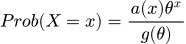
where g(θ) is the aforementioned convergent sum of the sequence:
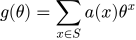
This notation exists because S is a set of non-negative integers, usually the infinite set {0, 1, 2, ...}, but sometimes instead a finite set. This notation is a convenient abstraction. But in fact, if S is infinite, it is more appropriate to define the following partial sum function:

...and then take g(θ) to be the limit of gn(θ) as n goes to infinity.
Examples of discrete probability mass functions that are special cases of this generalized distribution:
Distribution name |
θ |
a(x) |
g(θ) |
S |
Binomial |
pi/(1-pi) |
(nx) |
(1+theta)n = (1+(pi/(1-pi))n |
{0,1,2,...,n} |
Poisson |
lambda |
1/x! |
etheta = elambda |
{0, 1, 2, ...} |
The cumulative distribution function is given by:
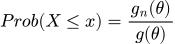
(Re-using the above partial sum function.)
Properties
Note that probability generating functions are not the same as the probability mass function of the power series distribution. The former uses a probability mass function as the generating function on the power series of a dummy variable. The latter derives the probability mass function from a normalized power series. Naturally though, the common elements between these two concepts leads to a convenient expression for the probability generating function:

(Again re-using the above partial sum function.)