
A Comparison of Methods of Weighting Adjustment for Nonresponse
A Comparison of Methods of Weighting Adjustment for Nonresponse was written by Graham Kalton and Dalisay S. Maligalig in 1991. It was published in the proceedings of the 1991 Annual Research Conference of the Census Bureau. The scan can be found online at https://books.google.com/books?lr=&id=Cy22AAAAIAAJ&pg=PA409.
The estimator for population proportion Y̅ is  where πi is the probability of element i being sampled.
Given element nonresponse, the estimator becomes 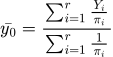 where r is the number of respondents. The bias is approximated by
  where ϕi is the probability of element i responding if sampled. This bias relates to the covariance of Yi and ϕi; if covariance is 0, then bias is 0.
If ϕi are known, use the corrected estimator 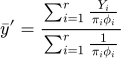 . But realistically we can only estimate those probabilities, and then use
  . Three methods follow:
The simplest model is to assume constant probability of responding if sampled, i.e. ϕi = ϕ ∀ i.
The recommendation is to model ϕi using logistic regression, i.e. log(ϕi/(1-ϕi)) = xiβ given some auxiliary information xi.
- The remainder of the paper addresses three alternative methods.
Population-based adjustment cell weighting
The first method the authors introduce is a population-based adjustment cell weighting, partitioning the population into cells indexed by h. The estimator is 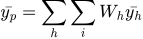 where Wh = Nh/N, rh is the number of respondents in cell h, and the cell mean is given by
  . Alternatively,
 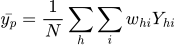 where whi is an element's weight. The bias of this estimator is
  .
.
Similar to before, this estimator's bias relates to the covariance of Yhi and ϕhi. Importantly though it derives from covariance within the cell. Therefore if the probability to respond is constant within a cell, i.e. ϕhi = ϕh, there is no bias. E[y̅p] = Y̅ and MSE(y̅p) = Var(y̅p) = ΣW2hS2h/rh where S2h is the element variance within cell h.
Consider two schemes:
scheme 1 uses H cells
scheme 2 collapses cells 1 and 2 together, rendering H-1 cells
The collapse leads to the second scheme having lower variance. At the same time, the bias becomes  . Making assumptions about element variance, MSE(y̅p1) > MSE(y̅p2) if
 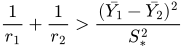 .
.
Sample-based adjustment cell weighting
The authors also introduce a sample-based method. Importantly, making parallel assumptions, they arrive to the same expression for when collapsing yields a lower MSE.
Raking ratio weighting
Finally, the authors introduce a raking method with two dimensions, one indexed by h and the other indexed by k. The estimator is where w̃hk estimates Whk in the joint distribution through iterative fitting. More formally, E[w̃hk] = Whk. More concretely, at convergence, the weights reflect the marginal distributions expressed as Wk = ΣhWhk = Σhw̃hk and Wh = ΣkWhk = Σkw̃hk.
The authors make a parallel assumption to the above: that the probability to respond is constant within a cell, i.e. ϕhki = ϕhk. At the same time, they loosen the assumption that w̃hk converges to Whk.
If E[w̃hk] = W̃hk, then bias of this estimator is then given by Bias(y̅p) = ΣΣ(W̃hk - Whk)(Y̅hk - Y̅h - Y̅k + Y̅). Therefore, even when w̃hk is a biased estimator for Whk, this can be an unbiased estimator for Y̅ if there is no interaction in Yhk for the two-way classification.
If Whk are known, the authors demonstrate that variance under adjustment cell weighting is lower than or equal to variance under raking ratio weighting. "An argument advanced for the use of raking is that it deals with the problem of small cells. To the extent that it does so, it operates in an indirect manner. When the Whk distribution is known, it is not clear why raking should be preferred to adjustment cell weighting. With the latter procedure, weights can be trimmed and cells collapsed in a way that is tailor-made for the survey variables under study and for the particular sample configuration encountered. Further research is needed in this area."
Reading notes
The authors do actually discuss how the selection of estimators occurs after observing the response patterns, so they take r̃ as given, i.e. E[y̅p|r̃] = Y̅. I omit this from my notes for brevity and because r̃ is inconvenient to type.