
|
Size: 3362
Comment: Typo
|
Size: 3355
Comment: Links
|
| Deletions are marked like this. | Additions are marked like this. |
| Line 21: | Line 21: |
| Strong assumptions about the variance structure are made. | Strong assumptions about the (co-)variance structure are made. |
| Line 24: | Line 24: |
| * Therefore the covariance of errors between two measurements of the same individual is: | * Therefore the [[Statistics/Covariance|covariance]] of errors between two measurements of the same individual is: |
| Line 29: | Line 29: |
| * For the same reasons, the '''variance''' of errors (i.e., the covariance between a measurement and itself) simplifies to ''σ,,α,,^2^ + σ,,u,,^2^''. | * For the same reasons, the [[Statistics/Variance|variance]] of errors simplifies to ''σ,,α,,^2^ + σ,,u,,^2^''. |
Random Effects Model
A random effects model utilizes repeated observations (i.e., panel data) to decompose and correct for within-group and between-group heterogeneity.
Contents
Description
This model is used for panel analysis.
A good starting point for modeling with panel data is the pooled OLS model. This model builds upon weaknesses of that methodology.
It is helpful to establish a decomposition for the unit error term εit into time-variant and time-invariant components: uit and αi.
Also, consider N to the total number of observations. If using a balanced panel, i.e. all individuals i have T observations, this is simply nT. More generally though, the calculation is  .
.
Strong assumptions about the (co-)variance structure are made.
Errors are distributed about 0, i.e. E[εit] = 0.
Therefore the covariance of errors between two measurements of the same individual is:
Cov(εit, εis) = E[(εit - 0)(εis - 0)] = E[εitεis]
Cov(εit, εis) = E[(uit + αi)(uis + αi)] = E[uituis + uitαi + uisαi + αi2]
- The components of errors are independent.
The above simplifies to σα2.
For the same reasons, the variance of errors simplifies to σα2 + σu2.
- There is zero covariance between the errors and any predictor.
The first two lead to a Ti by Ti covariance matrix for any individual i:

Furthermore, the covariance matrix for all individuals and all measurements can be fully expressed in a N by N covariance matrix like:

Note that all off-diagonal covariances are zero unless individuals i and j are the same.
The final assumption is important because the total errors, ε composed of εit, can then be calculated using a de-meaned within estimator. The diagonal members can be summed and averaged to arrive at σε2:

There are a few different estimators for σα2, but the simplest intuition is summing and averaging the off-diagonal members.
Feasible GLS is used to fit the random effects model. This can be interpreted as transforming the space by weights, θ composed of θi, that mix observations with individual-level averages.
The weights are specified as:
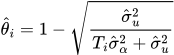
And the random effects model can be formulated as:

As θi approaches 1, this model converges to the fixed effects model. As θi approaches 0, this model converges to a pooled OLS model.
Because of this nesting and the fact that the fixed effects model is less efficient but must be consistent, a Hausman test should be performed with the null hypothesis that the random effects model is consistent. If rejected, the fixed effects model should be used instead.