
|
Size: 1453
Comment: Clarification
|
Size: 3360
Comment: Test
|
| Deletions are marked like this. | Additions are marked like this. |
| Line 17: | Line 17: |
| It is helpful to establish a decomposition for the unit error term ''ε,,it,,'' into time-variant and time-invariant components: ''u,,it,,'' and ''α,,i,,''. Strong assumptions about these variances are made. Importantly, there must be zero covariance between predictors and the error. With this, the covariance matrix of errors for the measurements all individuals ''i'' over time can be fully expressed in a ''T'' by ''T'' covariance matrix like: | It is helpful to establish a decomposition for the unit error term ''ε,,it,,'' into time-variant and time-invariant components: ''u,,it,,'' and ''α,,i,,''. Also, consider ''N'' to the total number of observations. If using a balanced panel, i.e. all individuals ''i'' have ''T'' observations, this is simply ''nT''. More generally though, the calculation is {{attachment:n.svg}}. Strong assumptions about the variance structure are made. * Errors are distributed about 0, i.e. ''E[ε,,it,,] = 0''. * Therefore the covariance of errors between two measurements of the same individual is: * ''Cov(ε,,it,,, ε,,is,,) = E[(ε,,it,, - 0)(ε,,is,, - 0)] = E[ε,,it,,ε,,is]'' * ''Cov(ε,,it,,, ε,,is,,) = E[(u,,it,, + α,,i,,)(u,,is,, + α,,i,,)] = E[u,,it,,u,,is,, + u,,it,,α,,i,, + u,,is,,α,,i,, + α,,i,,^2^]'' * The components of errors are independent. * The above simplifies to ''σ,,α,,^2^''. * For the same reasons, the '''variance''' of errors (i.e., the covariance between a measurement and itself) simplifies to ''σ,,α,,^2^ + σ,,u,,^2^''. * There is zero covariance between the errors and any predictor. The first two lead to a ''T,,i,,'' by ''T,,i,,'' covariance matrix for any individual ''i'': |
| Line 21: | Line 36: |
| Note that all off-diagonal coveriances are simply the within-group heterogeneity, the time-variant error. Furthermore, the covariance matrix for all individuals and all measurements can be fully expressed in a ''NT'' by ''NT'' covariance matrix like: | Furthermore, the covariance matrix for all individuals and all measurements can be fully expressed in a ''N'' by ''N'' covariance matrix like: |
| Line 25: | Line 40: |
| Note that all off-diagonal covariances are zero unless indiviuals ''i'' and ''j'' are the same. | Note that all off-diagonal covariances are zero unless individuals ''i'' and ''j'' are the same. |
| Line 27: | Line 42: |
| The consequence of this specification is that errors can be estimated using a pooled OLS model. | The final assumption is important because the total errors, '''''ε''''' composed of ''ε,,it,,'', can then be calculated using a [[Statistics/FixedEffectsModel#De-meaned_Estimator|de-meaned within estimator]]. The diagonal members can be summed and averaged to arrive at ''σ,,ε,,^2^'': {{attachment:within1.svg}} There are a few different estimators for ''σ,,α,,^2^'', but the simplest intuition is summing and averaging the off-diagonal members. [[Statistics/GeneralizedLeastSquares|Feasible GLS]] is used to fit the random effects model. This can be interpreted as transforming the space by weights, '''''θ''''' composed of ''θ,,i,,'', that mix observations with individual-level averages. The weights are specified as: {{attachment:theta.svg}} And the random effects model can be formulated as: {{attachment:re.svg}} As ''θ,,i,,'' approaches 1, this model converges to the fixed effects model. As ''θ,,i,,'' approaches 0, this model converges to a pooled OLS model. Because of this nesting and the fact that the fixed effects model is less efficient but must be consistent, a [[Statistics/HausmanTest|Hausman test]] should be performed with the null hypothesis that the random effects model is consistent. If rejected, the fixed effects model should be used instead. |
Random Effects Model
A random effects model utilizes repeated observations (i.e., panel data) to decompose and correct for within-group and between-group heterogeneity.
Contents
Description
This model is used for panel analysis.
A good starting point for modeling with panel data is the pooled OLS model. This model builds upon weaknesses of that methodology.
It is helpful to establish a decomposition for the unit error term εit into time-variant and time-invariant components: uit and αi.
Also, consider N to the total number of observations. If using a balanced panel, i.e. all individuals i have T observations, this is simply nT. More generally though, the calculation is  .
.
Strong assumptions about the variance structure are made.
Errors are distributed about 0, i.e. E[εit] = 0.
- Therefore the covariance of errors between two measurements of the same individual is:
Cov(εit, εis) = E[(εit - 0)(εis - 0)] = E[εitε,,is]
Cov(εit, εis) = E[(uit + αi)(uis + αi)] = E[uituis + uitαi + uisαi + αi2]
- Therefore the covariance of errors between two measurements of the same individual is:
- The components of errors are independent.
The above simplifies to σα2.
For the same reasons, the variance of errors (i.e., the covariance between a measurement and itself) simplifies to σα2 + σu2.
- There is zero covariance between the errors and any predictor.
The first two lead to a Ti by Ti covariance matrix for any individual i:

Furthermore, the covariance matrix for all individuals and all measurements can be fully expressed in a N by N covariance matrix like:

Note that all off-diagonal covariances are zero unless individuals i and j are the same.
The final assumption is important because the total errors, ε composed of εit, can then be calculated using a de-meaned within estimator. The diagonal members can be summed and averaged to arrive at σε2:

There are a few different estimators for σα2, but the simplest intuition is summing and averaging the off-diagonal members.
Feasible GLS is used to fit the random effects model. This can be interpreted as transforming the space by weights, θ composed of θi, that mix observations with individual-level averages.
The weights are specified as:
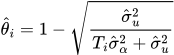
And the random effects model can be formulated as:

As θi approaches 1, this model converges to the fixed effects model. As θi approaches 0, this model converges to a pooled OLS model.
Because of this nesting and the fact that the fixed effects model is less efficient but must be consistent, a Hausman test should be performed with the null hypothesis that the random effects model is consistent. If rejected, the fixed effects model should be used instead.