
|
Size: 1577
Comment: Simplify
|
← Revision 14 as of 2025-11-03 01:35:01 ⇥
Size: 1611
Comment: Link
|
| Deletions are marked like this. | Additions are marked like this. |
| Line 1: | Line 1: |
| = OLS Univariate Derivation = | = OLS Single Regression Derivation = |
| Line 25: | Line 25: |
| * and ''r,,XY,,'' is the sample correlation coefficient between ''X'' and ''Y'' (estimating ''ρ,,XY,,'') | * and ''r,,XY,,'' is the sample [[Statistics/Correlation|correlation]] coefficient between ''X'' and ''Y'' (estimating ''ρ,,XY,,'') |
OLS Single Regression Derivation
The model is constructed like:

The model is fit by a minimization problem:
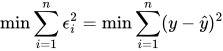
This is estimated as:

This line must pass through the mean and the slope of the line must be the marginal change in Y given a unit change in X. In other words, the line must pass through two points:

where:
X‾ is the sample mean of X (estimating μX)
Y‾ is the sample mean of Y (estimating μY)
sX is the sample standard deviation of X (estimating σX)
sY is the sample standard deviation of Y (estimating σY)
and rXY is the sample correlation coefficient between X and Y (estimating ρXY)
Insert the first point into the estimation. This is quickly solved for α.


Insert the second point and the solution for α into the estimation.



This reduced form can be quickly solved for β.

Because the correlation coefficient can be expressed in terms of covariance and standard deviations...

...the solution for β can be further reduced.

Therefore, the regression line is estimated to be:
