
|
Size: 1086
Comment: Clarifications and content
|
Size: 1149
Comment: Clarification
|
| Deletions are marked like this. | Additions are marked like this. |
| Line 13: | Line 13: |
| Outcomes are coded as 0 and 1. A linear model is constructed (as '''''x''' = '''Xb''''') to predict outcomes using one or more independent variables. | Outcomes are coded as 0 and 1. A linear model is constructed (as '''''y''' = '''Xb''''') to predict outcomes using one or more independent variables. |
| Line 23: | Line 23: |
| The fitted parameters of this model are in terms of '''logits''' or '''log odds'''. The '''logit function''' is the inverse of the logistic function. | The ''x'' term here expands to the entire linear model. The fitted parameters of the model then are in terms of '''logits''' or '''log odds'''. The '''logit function''' is the inverse of the logistic function. |
Logistic Model
A logistic model is a linear regression method for a binary outcome.
Contents
Design
Outcomes are coded as 0 and 1. A linear model is constructed (as y = Xb) to predict outcomes using one or more independent variables.
The intention of the model is to predict the probability of outcome 1. As always, a probability must be a number between 0 and 1. The linear model as specified can produce any number, however. To connect the linear model to expected values, the logistic function is used as a link function.

This function plots as an S-shaped line, so is sometimes called a sigmoid function.
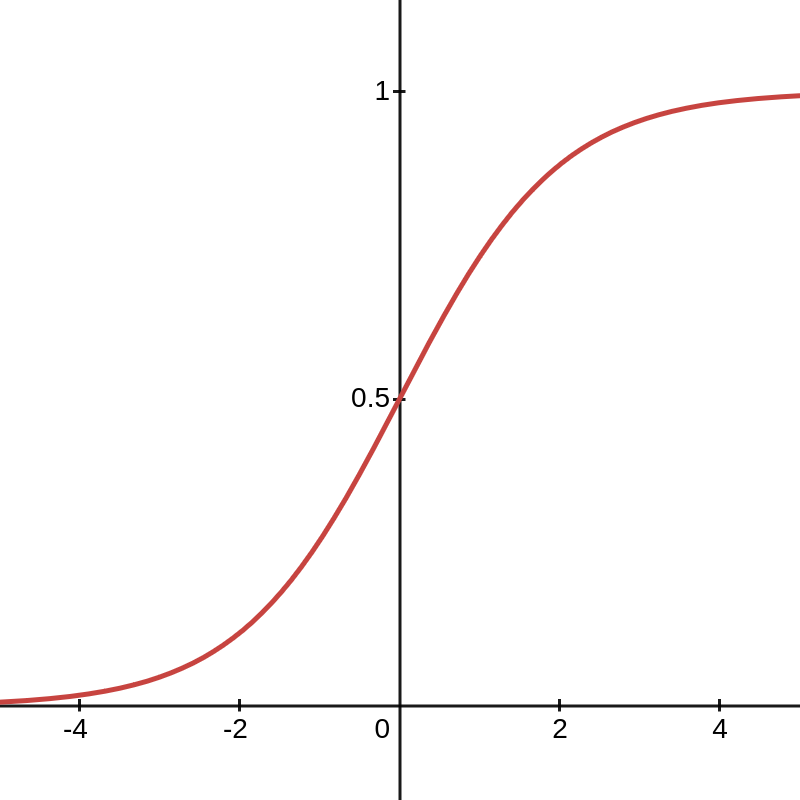
The x term here expands to the entire linear model.
The fitted parameters of the model then are in terms of logits or log odds. The logit function is the inverse of the logistic function.

To be clear: logistic(x) = p and logit(p) = x.