|
Size: 2153
Comment: Rewrite 1
|
Size: 3383
Comment: Killing Econometrics page
|
| Deletions are marked like this. | Additions are marked like this. |
| Line 1: | Line 1: |
| ## page was renamed from Econometrics/Notation | |
| Line 25: | Line 26: |
| == Statistics == There is a mixture of notations for scalar statistics. The conventional estimators for population mean ''μ'', variance ''σ^2^'', standard deviation ''σ'', covariance ''σ,,xy,,'', and correlation ''ρ,,xy,,'' are: {{attachment:average.svg}} {{attachment:variance.svg}} {{attachment:sd.svg}} {{attachment:covariance.svg}} {{attachment:correlation.svg}} Frequently for multiple variable statistics, some pieces of [[LinearAlgebra|linear algebra]] notation are introduced. For example, covariances are frequently expressed in a covariance matrix. Covariances of ''x'' and ''y'' are specified as ''σ,,xy,,''; variances are expressed as covariances of ''x'' and ''x''. {{attachment:covariancem.svg}} |
|
| Line 29: | Line 50: |
| For multiple variables, pieces of [[LinearAlgebra|linear algebra]] notation are introduced. For example, the joint statement of [[Econometrics/Exogeneity|exogeneity]] and [[Econometrics/Homoskedasticity|homoskedasticity]] is: | For multiple variables, at minimum the distribution is specified as ''NI'' to emphasize independence of the distributions. Some pieces of [[LinearAlgebra|linear algebra]] notation are also introduced. For example, the joint statement of [[Econometrics/Exogeneity|exogeneity]] and [[Econometrics/Homoskedasticity|homoskedasticity]] is: |
| Line 33: | Line 54: |
| Note how the covariance matrix is fully expressed as the [[LinearAlgebra/SpecialMatrices#Diagonal_Matrices|diagonal matrix]] of each term's variance. | |
| Line 35: | Line 57: |
| == Statistics == | |
| Line 37: | Line 58: |
| The average outcome is: | == Modeling == |
| Line 39: | Line 60: |
| {{attachment:average.svg}} | A univariate model is specified with a constant term ''α'' and a coefficient term ''β''. A multivariate model of ''j'' variables specifies constant ''β,,0,,'' and coefficients ''β,,1,,'' through ''β,,j,,''. A [[LinearAlgebra|linear algebra]] notation uses a coefficient vector ''β'' of size ''p''. |
| Line 41: | Line 62: |
| The variance is: | In any case, when a model is estimated, the estimated coefficients are notated differently. Scalar notations attach a hat, as in ''βˆ,,0,,''. The linear algebra notation replaces ''β'' with ''b''. |
| Line 43: | Line 64: |
| {{attachment:variance.svg}} | The predicted outcome from a model is also marked as an estimate by attaching a hat: ''yˆ''. |
| Line 45: | Line 66: |
| The standard deviation is: | The generic calculation of the residual for observation ''i'' is ''y,,i,, - yˆ,,i,,''. The sum of square residuals (SSR) is what is minimized to fit a model. |
| Line 47: | Line 68: |
| {{attachment:sd.svg}} The covariance between the treatment and outcome is: {{attachment:covariance.svg}} The correlation between the treatment and outcome is: {{attachment:correlation.svg}} Based on [[Econometrics/OrdinaryLeastSquares|OLS regression]], the estimated outcome for observation ''i'' is: {{attachment:estimate.svg}} No matter the regression method, the residual is: {{attachment:residual.svg}} And the coefficient of determination, a.k.a. the ''R^2^'', is: |
And the coefficient of determination is: |
Econometrics Notation
Observations and Measurements
The number of observations is n.
The outcome variable is y. The outcome measurement for observation i is yi.
If there is a single predictor, it may be specified as x; the measurement is xi. More commonly, there is a set of predictors specified like x1, x2, and so on. The measurements are then x1i, x2i, and so on.
When expressing data with linear algebra, the outcome measurements are composed into vector y with size n, and the predictor measurements are composed into matrix X of shape n by p.
A very common exception: income is usually represented by Y or y. In relevant literature, expect to see different letters.
Error Terms
Error terms are variably represented by ε, e, u, or v. The error term for observation i would be represented like εi.
Statistics
There is a mixture of notations for scalar statistics. The conventional estimators for population mean μ, variance σ2, standard deviation σ, covariance σxy, and correlation ρxy are:
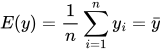



Frequently for multiple variable statistics, some pieces of linear algebra notation are introduced. For example, covariances are frequently expressed in a covariance matrix. Covariances of x and y are specified as σxy; variances are expressed as covariances of x and x.

Distributions
The normal distribution is frequently expressed in econometrics. The typical notation is xi ~ N(μ, σ).
For multiple variables, at minimum the distribution is specified as NI to emphasize independence of the distributions. Some pieces of linear algebra notation are also introduced. For example, the joint statement of exogeneity and homoskedasticity is:
![[ATTACH]](/Statistics/EconometricsNotation?action=AttachFile&do=upload_form&target=exo.svg&ticket=006a66d9c2.e2640abfadff713d656d012370d638c932f31415 "[ATTACH]")
Note how the covariance matrix is fully expressed as the diagonal matrix of each term's variance.
Modeling
A univariate model is specified with a constant term α and a coefficient term β. A multivariate model of j variables specifies constant β0 and coefficients β1 through βj. A linear algebra notation uses a coefficient vector β of size p.
In any case, when a model is estimated, the estimated coefficients are notated differently. Scalar notations attach a hat, as in βˆ0. The linear algebra notation replaces β with b.
The predicted outcome from a model is also marked as an estimate by attaching a hat: yˆ.
The generic calculation of the residual for observation i is yi - yˆi. The sum of square residuals (SSR) is what is minimized to fit a model.
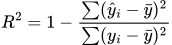
And the coefficient of determination is: