
|
Size: 3170
Comment: Space
|
← Revision 12 as of 2026-02-04 04:32:14 ⇥
Size: 2186
Comment: Adding row space solution
|
| Deletions are marked like this. | Additions are marked like this. |
| Line 3: | Line 3: |
| [[LinearAlgebra/Elimination|Elimination]] and other factorizations offer a method for obtaining the '''particular solutions''' (''x,,p,,'') of a linear system. The '''complete solution''' (''x,,c,,'') is the generalized answer. | A '''complete solution''' is a generalization of a [[LinearAlgebra/ParticularSolution|particular solution]]. It is generally notated as ''x,,c,,''. |
| Line 11: | Line 11: |
| == Introduction == | == Description == A consistent linear system has either one or infinitely many solutions. The '''general solution''' describes all of them. A complete solution is formalized as ''x,,c,, = x,,p,, + x,,0,,''. That is, the [[LinearAlgebra/Basis|basis]] of the [[LinearAlgebra/NullSpace#Solution|null space]] must be identified, and linear combinations of it must be added to the [[LinearAlgebra/ParticularSolution|particular solution]]. Since all such combinations evaluate to 0, they have an identity property. ---- |
| Line 15: | Line 21: |
| === First Example === | == Solution == |
| Line 17: | Line 23: |
| The example used here [[LinearAlgebra/Elimination|here]]: {{{ x + 2y + z = 2 3x + 8y + z = 12 4y + z = 2 }}} Is rewritten as a linear system and eliminated into: {{{ ┌ ┐ ┌ ┐ ┌ ┐ │[1] 2 1 │ │ x│ │ 2│ │ 0 [2] -2 │ │ y│ = │ 6│ │ 0 0 [5]│ │ z│ │-10│ └ ┘ └ ┘ └ ┘ }}} This system solved to ''x=2, y=1, z=-2''. There is also the unstated [[LinearAlgebra/NullSpaces#Zero_Vector_as_a_Solution|zero vector solution]] of ''x=0, y=0, z=0''. This is the complete solution for an invertible matrix. === Second Example === Consider a system with free variables: |
Consider the system: |
| Line 49: | Line 31: |
| This system is rewritten as a linear system and eliminated into: | It was noted [[LinearAlgebra/ParticularSolution#Solutions|here]] that a particular solution is ''[-2 0 3/2 0]''. |
| Line 51: | Line 33: |
| {{{ ┌ ┐ ┌ ┐ ┌ ┐ │[1] 2 2 2│ │ w│ │ 1│ │ 0 0 [2] 4│ │ x│ = │ 3│ │ 0 0 0 0│ │ y│ │ 0│ └ ┘ │ z│ └ ┘ └ ┘ }}} |
Furthermore, it was noted [[LinearAlgebra/NullSpace#Solutions|here]] that a [[LinearAlgebra/Basis|basis]] for the null space is ''{[-2 1 0 0], [2 0 -2 1]}''. The null space solution is ''any'' linear combination of these vectors. Consider: |
| Line 60: | Line 35: |
| The columns without a pivot correspond to free variables. For any set of values in the free variable positions, there is some '''particular solution''' that satisfies the system. So aim for the simplest particular solution, where every free variable is set to 0. Then solve algebraically for the pivot variables: | {{attachment:null.svg}} |
| Line 62: | Line 37: |
| {{{ 2y + 4z = 3 2y + 4(0) = 3 2y = 3 y = 3/2 |
Altogether, the complete solution for the second example above is ''x,,c,, = x,,p,, + x,,0,,''. |
| Line 68: | Line 39: |
| w + 2x + 2y + 2z = 1 w + 2(0) + 2y + 2(0) = 1 w + 2y = 1 w + 2(3/2) = 1 w + 3 = 1 w = -2 }}} ''w=-2, x=0, y=3/2, z=0'' is a solution. There is also the unstated [[LinearAlgebra/NullSpaces#Zero_Vector_as_a_Solution|zero vector solution]] of ''x=0, y=0, z=0''. But there are also infinitely many ''other'' solutions making use of the free variables. |
{{attachment:complete.svg}} |
| Line 82: | Line 45: |
| == Complete Solution == | == Row Space Solution == |
| Line 84: | Line 47: |
| The '''complete solution''' is defined as ''x,,c,, = x,,p,, + x,,0,,''. That is, the [[LinearAlgebra/NullSpaces#Solution|null space]] must be solved and added to the particular solution. | An alternative strategy follows from calculating a particular solution and the null space. Next, [[LinearAlgebra/Projection|project]] the particular solution onto the null space. The projection is notated ''x,,n,,''. |
| Line 86: | Line 49: |
| The null space solutions are ''[-2 1 0 0]'' and ''[2 0 -1 1]'' for the second example above. | The given particular solution can be related to that projection as ''x,,p,, = x,,r,, + x,,n,,''. This should look similar to the formulation of a complete solution; there is a component spanning row space, and there is a another spanning null space. But the minimum [[LinearAlgebra/Norm|norm]] particular solution does not move through the null space at all. So, evaluate ''x,,r,, = x,,p,, - x,,n,,'' to arrive at the '''row space solution'''. |
| Line 88: | Line 51: |
| '''The''' null space solution is any linear combination of the null space solution'''s'''. Again, for the second example above: {{{ ┌ ┐ ┌ ┐ │ -2 │ │ 2 │ x = C │ 1 │ + C │ 0 │ 0 1│ 0 │ 2│ -1 │ │ 0 │ │ 1 │ └ ┘ └ ┘ }}} Altogether, the complete solution for the second example above is: {{{ ┌ ┐ ┌ ┐ ┌ ┐ │ -2 │ │ -2 │ │ 2 │ │ 0 │ + C │ 1 │ + C │ 0 │ │ 3/2│ 1│ 0 │ 2│ -1 │ │ 0 │ │ 0 │ │ 1 │ └ ┘ └ ┘ └ ┘ }}} |
The optimized complete solution is ''x,,c,, = x,,r,, + c x,,n,,''. |
General Solution
A complete solution is a generalization of a particular solution. It is generally notated as xc.
Description
A consistent linear system has either one or infinitely many solutions. The general solution describes all of them.
A complete solution is formalized as xc = xp + x0. That is, the basis of the null space must be identified, and linear combinations of it must be added to the particular solution. Since all such combinations evaluate to 0, they have an identity property.
Solution
Consider the system:
w + 2x + 2y + 2z = 1
2w + 4x + 6y + 8z = 5
3w + 6x + 8y + 10z = 6
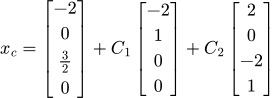
It was noted here that a particular solution is [-2 0 3/2 0].
Furthermore, it was noted here that a basis for the null space is {[-2 1 0 0], [2 0 -2 1]}. The null space solution is any linear combination of these vectors. Consider:
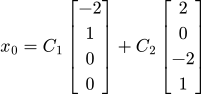
Altogether, the complete solution for the second example above is xc = xp + x0.
Row Space Solution
An alternative strategy follows from calculating a particular solution and the null space. Next, project the particular solution onto the null space. The projection is notated xn.
The given particular solution can be related to that projection as xp = xr + xn. This should look similar to the formulation of a complete solution; there is a component spanning row space, and there is a another spanning null space. But the minimum norm particular solution does not move through the null space at all. So, evaluate xr = xp - xn to arrive at the row space solution.
The optimized complete solution is xc = xr + c xn.