
|
Size: 4251
Comment: Relabel
|
Size: 4019
Comment: Cleanup
|
| Deletions are marked like this. | Additions are marked like this. |
| Line 67: | Line 67: |
| For a conservative ''F'' in two dimensions (''x'' and ''y''), the following is true: | [[Calculus/Divergence|Divergence]] of a conservative vector field ''F'' can be calculated as: |
| Line 70: | Line 70: |
where ''f,,xx,, = ∂^2^f/∂x^2^'' and ''f,,yy,, = ∂^2^f/∂y^2^''. For a conservative ''F'' in three dimension (''x'', ''y'', and ''z'') the following is true: {{attachment:laplace2.svg}} where ''f,,zz,, = ∂^2^f/∂z^2^''. |
Vector Field
A vector field represents direction and magnitude at all points in a coordinate system.
Contents
Description
A vector field F is defined for some domain D and maps points to a vector. Generally the vectors have as many dimensions as the coordinate system. That is, a point (x,y) maps to a vector <P,Q>; a point (x,y,z) maps to a vector <P,Q,R>.
A vector field's domain can be characterized as simply connected, connected, or not connected.
Conservative Fields
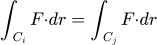
A conservative field is path independent. That is, for all Ci that connect A to B and are entirely within D,
Cross-Partial Property of Conservative Fields
A conservative field must satisfy the cross-partial property.
In two dimensions the property specifies that, given F = <P(x,y), Q(x,y)>,

In three dimensions is specifies that, given F = <P(x,y,z), Q(x,y,z), R(x,y,z)>,


Equivalently, test if the curl of F is 0.
If the domain D is simply connected, then satisfying this property is enough to confirm that a vector field is conservative. Otherwise there are more edge cases to consider.
Identifying the Field's Function
if a vector field is conservative, then there exists at least one function f satisfying F = ∇f. There is a general process for identifying this function f.
As an example, consider a vector field given as F = <P(x,y), Q(x,y)>.
Integrate P with respect to x. This produces a function like g(x,y) + h(y) where h(y) is unknown, encompasses the constant C, and accounts for variation in all variables that were held constant for the partial integration.
Derive g(x,y) + h(y) with respect to y. This produces a function like gy(x,y) + h'(y).
Set gy(x,y) + h'(y) equal to Q(x,y) and solve for h'(y).
Integrate h'(y), solving for the actual h(y).
The gradient function is g(x,y) + h(y) + C.
Laplace Operator
Divergence of a conservative vector field F can be calculated as:

The ∇2 expression is the Laplace operator.
Source-Free Fields
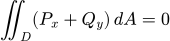
A vector field is source-free if there is zero divergence. This means that there are no sources (points where the field originates) or sinks (points where the field terminates). A consequence is that, for any closed curve or surface, there is zero flux.
To summarize, these are tests for a source-free field:

 for a smooth closed curve C
  for a vector field given as F=<P,Q>
  for a vector field given as F=<P,Q>
If a vector field is source-free, there is at least one stream function g. If the field is given as F=<P,Q>, then g must satisfy:

Conservative and Source-Free Fields
If vector field F is both conservative and source-free, then following from the above definition of the Laplace operator and the above property of divergence for source-free fields, it must be that:
∇2f = 0
which can be evaluated as fxx + fyy = 0 in two dimensions or fxx + fyy + fz = 0 in three. This is Laplace's equation.
Such a function f is harmonic.
Irrotational Fields
A vector field is irrotational if there is zero curl.