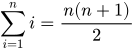
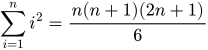
Series
A series is the sum of a finite or infinite sequence.
Description
A sequence can be finite or infinite. In the former case, these are often expressed with literal values like {1, 2, 3}. In the latter case, a builder syntax is most often used; for example {1/n}. If the trend is obvious, an infinite sequence could be written like {1, 2, 3, ...}.
Arithmetic Sequences
An arithmetic sequence can be expressed as an = a1 + (n - 1)d where d is the step size and a0 is the first (n = 1) term.
An infinite arithmetic series is always infinite.
However, the partial sum (i.e., cumulative up to n terms) can be calculated as:

Geometric Sequences
A geometric sequence can be expressed as an = a1r(n-1) where r is the rate and a0 is the first (n = 1) term.
An infinite geometric series only converges if |r| < 1. (Note that if |r| = 1 then the sequence is not actually geometric.) In the case that the series converges, it is calculated as:
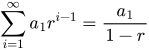
A partial sum is calculated as:

In some cases, a geometric sequence is instead formulated as an = arn. Note that a is not the same as a1, so the first (n = 1) term should be calculated.
Notable Series
Some notable series to be aware of: