
Reordering Integration
Reordering integration is a common strategy for evaluating a multiple integral.
Contents
Description
Multiple integrals have a strict ordering, usually indicated by the order of differentials trailing the integrand. For example, given ∫ ∫ f(t,u) du dt, the integral of f with respect to u must be taken first.
For some functions, the given order is inconvenient (or even impossible) to evaluate. Consider:
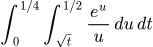
This can only be evaluated by changing the order of integration to:
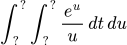
The trick is determining the new bounds for the integration. Identifying these generally requires a graphic visualization.
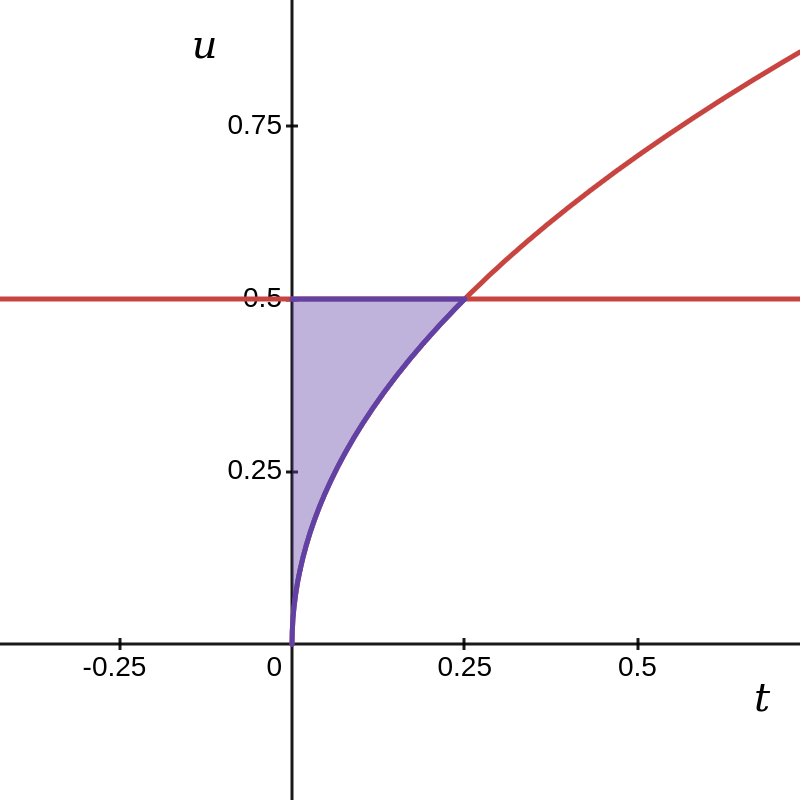
In the original expression, the outer integration (with respect to t) ranged from 0 to 0.25. The inner integration (with respect to u) was bounded by 0 and 0.5, but that upper bound was not given in literal terms; it was instead expressed in terms of t. Note that given √t, 0.25 evaluates to 0.5.
In the rewritten expression, the outer integration (with respect to u) should range from 0 to 0.5, and the inner integration (with respect to t) should effectively range from 0 to 0.25. The upper bound should be given in terms of u however. Before referencing the graph, it is clear that the upper bound should map 0.5 to 0.25. The graph clarifies that the upper bound should be described as u2.
In summary, the integral with a changed ordered of integration is:
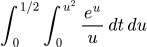
Which evaluates easily as:
