
|
Size: 1741
Comment: Typo
|
Size: 2898
Comment: Greens
|
| Deletions are marked like this. | Additions are marked like this. |
| Line 59: | Line 59: |
| If ''C'' is closed and circular, i.e. there are no endpoints, the integral is notated as | If ''C'' is closed and circular, i.e. there are no endpoints, the integral is notated like |
| Line 62: | Line 62: |
and is generally evaluated using '''Green's theorem'''. ---- == Green's Theorem == '''Green's theorem''' enables conversion between [[Calculus/Integral|double integrals]] and line integrals along a closed and circular curve ''C''. Consider a [[Calculus/VectorField|vector field]] expressed as ''F = <P(x,y), Q(x,y)>'' and a closed circular curve ''C'' [[Calculus/ParametricEquation|parameterized]] as ''r(t) = <x(t), y(t)>''. The '''circulation form''' of the theorem states that: \oint_C F \cdot T ds = \oint_C Pdx + Qdy = \iint_D(Q_x - P_y)\,dA for a ''C'' that is oriented counter-clockwise. (For a clockwise oriented ''C'', negate the formula.) In some cases, such an integral is expressed as being along the perimeter of a surface ''D'' rather than along curve ''C''. In this case ''C'' is substituted for ''∂D''. This can also be expressed in terms of [[Calculus/Curl|curl]], leading to it sometimes being called the '''curl form'''. \iint_D \mathrm{curl} \, F \cdot k \, dA The '''[[Calculus/Flux|flux]] form''' or '''normal form''' of the theorem states that: \oint_C F \cdot N ds = \iint_D(P_x + Q_y) \, dA |
Line Integral
A line integral is an integral along a smooth curve C.
Scalar Line Integral
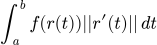
Given a smooth curve C, integrating a function f along C gives the scalar line integral. As the name implies, this returns a scalar value.

Parameterize f using r(t) for a ≤ t ≤ b to get:
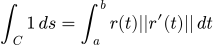
This gives a straightforward calculation for arc length:
Vector Line Integral
A vector field F is defined for some domain D. Given a smooth curve C that exists entirely within D, the vector line integral is given by:

where T is the unit tangent vector.
Parameterize F using r(t) for a ≤ t ≤ b to get:

Another common notation follows from reformulating r'(t) as:


Therefore dr can be substituted into the above equation.

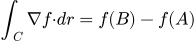
Lastly, if a vector field is conservative, then there exists at least one function f satisfying F = ∇f. If given the start and end points A and B of the curve C, then:

Or parameterize f using r(t) for a ≤ t ≤ b to get:
If C is closed and circular, i.e. there are no endpoints, the integral is notated like

and is generally evaluated using Green's theorem.
Green's Theorem
Green's theorem enables conversion between double integrals and line integrals along a closed and circular curve C.
Consider a vector field expressed as F = <P(x,y), Q(x,y)> and a closed circular curve C parameterized as r(t) = <x(t), y(t)>. The circulation form of the theorem states that:
\oint_C F \cdot T ds = \oint_C Pdx + Qdy = \iint_D(Q_x - P_y)\,dA
for a C that is oriented counter-clockwise. (For a clockwise oriented C, negate the formula.) In some cases, such an integral is expressed as being along the perimeter of a surface D rather than along curve C. In this case C is substituted for ∂D.
This can also be expressed in terms of curl, leading to it sometimes being called the curl form.
\iint_D \mathrm{curl} \, F \cdot k \, dA
The flux form or normal form of the theorem states that:
\oint_C F \cdot N ds = \iint_D(P_x + Q_y) \, dA