
|
Size: 510
Comment: Simple desc
|
← Revision 8 as of 2026-07-16 15:25:03 ⇥
Size: 3378
Comment: Rewrite
|
| Deletions are marked like this. | Additions are marked like this. |
| Line 13: | Line 13: |
| The limit of ''f'' as ''x'' approaches infinity is notated as: | Consider the limit of ''f(x)'' as the input value approaches ''a''. There is a range of input values around ''a'' defined by being no more than ''δ'' away; this can almost be described as ''[a-δ,a+δ]'' but it excludes ''a'' itself. This range of input values maps to a constrained set of output values that are at most ''ε'' away from the limit of ''f(x)'' as it approaches ''a''; ''|f(x) - L| < ε''. A limit is defined wherever ''ε'' can be made smaller by making ''δ'' smaller. |
| Line 15: | Line 15: |
| {{attachment:lim1.svg}} | That is to say, if there are discontinuities preventing ''ε'' from being made any smaller, the limit is not defined. A limit is notated as: {{attachment:lim.svg}} |
| Line 19: | Line 23: |
| === Vector-Values Function === | === One-sided === |
| Line 21: | Line 25: |
| The limit of the vector-values function ''r(t) = f(t)i + g(t)j + h(t)k'' as ''t'' approaches ''a'' is given by: | In certain circumstances, it is useful to consider one-sided limits. This can be a solution to describing discontinuous function, in that input values to the other side do not need to converge on the limit. |
| Line 23: | Line 27: |
| {{attachment:lim2.svg}} | A '''right-handed limit''' approaches ''a'' from the right, and considers only the input values ''a < x'': {{attachment:limr.svg}} A '''left-handed limit''' approaches ''a'' from the left and considers only the input values ''x < a'': {{attachment:liml.svg}} This is primarily useful for thinking of '''infinite limits'''. The limit of ''f(x)'' as ''x'' approaches positive infinity is notated as: {{attachment:liminf1.svg}} The limit of ''f(x)'' as ''x'' approaches negative infinity is notated as: {{attachment:liminf2.svg}} === Vector-Valued Function === The limit of the vector-valued function ''r(t) = f(t)i + g(t)j + h(t)k'' as ''t'' approaches ''a'' is given by: {{attachment:vec.svg}} |
| Line 29: | Line 55: |
| === Multivariate Function === Instead of a range of input values mapping to a constrained set of outputs, consider a disk (or ball). The disk (or ball) is formed by all input coordinates defined by being having a [[Calculus/Distance#Euclidean_distance|distance]] from ''a'' less than ''δ'', but also not including ''a'' itself. The definition of a limit, and the description of when a limit exists, then follows the univariate case as above. Consider the limit of ''f(x,y)'' as it approaches ''(a,b)''. There is a disk of ''(x,y)'' coordinates around ''(a,b)'' such that: {{attachment:mult1.svg}} The limit is defined wherever ''ε'' can be made smaller by making ''δ'' smaller. It is notated as: {{attachment:mult2.svg}} ---- == Rewriting Limits == Limits can descend into continuous functions. That is, consider an inconvenient compound function like {{attachment:desc1.svg}}. Because exponentiation is a continuous function, this limit is equivalent to {{attachment:desc2.svg}}. === L'Hôpital's Rule === If the function being evaluated can be expressed as a ratio of two function (i.e., ''f/g''), it may be possible to calculate the limit using '''L'Hôpital's rule'''. {{attachment:rule.svg}} If the limit ordinarily evaluates to ''0/0'', or ''∞/∞'', or ''-∞/-∞'', then this rule is applicable. Importantly the signs must agree; ''∞/-∞'' is not applicable. In addition, the two functions must be [[Calculus/Derivative|differentiable]]. |
Limit
A limit is the value that a function approaches as the input approaches some value.
Contents
Description
Consider the limit of f(x) as the input value approaches a. There is a range of input values around a defined by being no more than δ away; this can almost be described as [a-δ,a+δ] but it excludes a itself. This range of input values maps to a constrained set of output values that are at most ε away from the limit of f(x) as it approaches a; |f(x) - L| < ε. A limit is defined wherever ε can be made smaller by making δ smaller.
That is to say, if there are discontinuities preventing ε from being made any smaller, the limit is not defined.
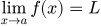
A limit is notated as:
One-sided
In certain circumstances, it is useful to consider one-sided limits. This can be a solution to describing discontinuous function, in that input values to the other side do not need to converge on the limit.
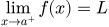
A right-handed limit approaches a from the right, and considers only the input values a < x:
A left-handed limit approaches a from the left and considers only the input values x < a:

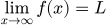
This is primarily useful for thinking of infinite limits. The limit of f(x) as x approaches positive infinity is notated as:
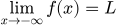
The limit of f(x) as x approaches negative infinity is notated as:
Vector-Valued Function
The limit of the vector-valued function r(t) = f(t)i + g(t)j + h(t)k as t approaches a is given by:

provided that the component limits exist.
Multivariate Function
Instead of a range of input values mapping to a constrained set of outputs, consider a disk (or ball). The disk (or ball) is formed by all input coordinates defined by being having a distance from a less than δ, but also not including a itself. The definition of a limit, and the description of when a limit exists, then follows the univariate case as above.
Consider the limit of f(x,y) as it approaches (a,b). There is a disk of (x,y) coordinates around (a,b) such that:

The limit is defined wherever ε can be made smaller by making δ smaller. It is notated as:

Rewriting Limits
Limits can descend into continuous functions. That is, consider an inconvenient compound function like  . Because exponentiation is a continuous function, this limit is equivalent to
  .
.
L'Hôpital's Rule
If the function being evaluated can be expressed as a ratio of two function (i.e., f/g), it may be possible to calculate the limit using L'Hôpital's rule.
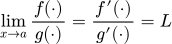
If the limit ordinarily evaluates to 0/0, or ∞/∞, or -∞/-∞, then this rule is applicable. Importantly the signs must agree; ∞/-∞ is not applicable.
In addition, the two functions must be differentiable.