
|
Size: 322
Comment: Initial commit
|
Size: 2611
Comment: Rewrite
|
| Deletions are marked like this. | Additions are marked like this. |
| Line 3: | Line 3: |
| A '''limit''' is the value that a function approaches as the input approaches some value. |
|
| Line 11: | Line 13: |
| Consider the limit of ''f(x)'' as the input value approaches ''a''. There is a range of input values around ''a'' defined by being no more than ''δ'' away; this can almost be described as ''[a-δ,a+δ]'' but it excludes ''a'' itself. This range of input values maps to a constrained set of output values that are at most ''ε'' away from the limit of ''f(x)'' as it approaches ''a''; ''|f(x) - L| < ε''. A limit is defined wherever ''ε'' can be made smaller by making ''δ'' smaller. That is to say, if there are discontinuities preventing ''ε'' from being made any smaller, the limit is not defined. A limit is notated as: {{attachment:lim.svg}} === One-sided === In certain circumstances, it is useful to consider one-sided limits. This can be a solution to describing discontinuous function, in that input values to the other side do not need to converge on the limit. A '''right-handed limit''' approaches ''a'' from the right, and considers only the input values ''a < x'': {{attachment:limr.svg}} A '''left-handed limit''' approaches ''a'' from the left and considers only the input values ''x < a'': {{attachment:liml.svg}} This is primarily useful for thinking of '''infinite limits'''. The limit of ''f(x)'' as ''x'' approaches positive infinity is notated as: {{attachment:liminf1.svg}} The limit of ''f(x)'' as ''x'' approaches negative infinity is notated as: {{attachment:liminf2.svg}} |
|
| Line 17: | Line 49: |
| {{attachment:lim.svg}} | {{attachment:vec.svg}} |
| Line 23: | Line 55: |
| === Multivariate Function === Instead of a range of input values mapping to a constrained set of outputs, consider a disk (or ball). The disk (or ball) is formed by all input coordinates defined by being having a [[Calculus/Distance#Euclidean_distance|distance]] from ''a'' less than ''δ'', but also not including ''a'' itself. The definition of a limit, and the description of when a limit exists, then follows the univariate case as above. Consider the limit of ''f(x,y)'' as it approaches ''(a,b)''. There is a disk of ''(x,y)'' coordinates around ''(a,b)'' such that: {{attachment:mult1.svg}} The limit is defined wherever ''ε'' can be made smaller by making ''δ'' smaller. It is notated as: {{attachment:mult2.svg}} |
Limit
A limit is the value that a function approaches as the input approaches some value.
Description
Consider the limit of f(x) as the input value approaches a. There is a range of input values around a defined by being no more than δ away; this can almost be described as [a-δ,a+δ] but it excludes a itself. This range of input values maps to a constrained set of output values that are at most ε away from the limit of f(x) as it approaches a; |f(x) - L| < ε. A limit is defined wherever ε can be made smaller by making δ smaller.
That is to say, if there are discontinuities preventing ε from being made any smaller, the limit is not defined.
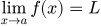
A limit is notated as:
One-sided
In certain circumstances, it is useful to consider one-sided limits. This can be a solution to describing discontinuous function, in that input values to the other side do not need to converge on the limit.
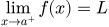
A right-handed limit approaches a from the right, and considers only the input values a < x:
A left-handed limit approaches a from the left and considers only the input values x < a:

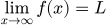
This is primarily useful for thinking of infinite limits. The limit of f(x) as x approaches positive infinity is notated as:
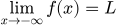
The limit of f(x) as x approaches negative infinity is notated as:
Vector-Values Function
The limit of the vector-values function r(t) = f(t)i + g(t)j + h(t)k as t approaches a is given by:

provided that the component limits exist.
Multivariate Function
Instead of a range of input values mapping to a constrained set of outputs, consider a disk (or ball). The disk (or ball) is formed by all input coordinates defined by being having a distance from a less than δ, but also not including a itself. The definition of a limit, and the description of when a limit exists, then follows the univariate case as above.
Consider the limit of f(x,y) as it approaches (a,b). There is a disk of (x,y) coordinates around (a,b) such that:

The limit is defined wherever ε can be made smaller by making δ smaller. It is notated as:
