
Jacobian Matrices and Determinants
A Jacobian matrix is a square matrix of partial derivatives.
A Jacobian is most commonly used to describe a change of coordinate systems or a change of basis. As the result, the determinant of such a matrix is called Jacobian determinant.
Contents
Description
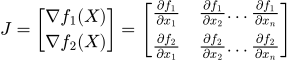
Consider a vector-valued function, such as a parameterized function, but for simplicity let F(X) = <f1(X), f2(X)> where X is a vector as X = <x1, x2, ... xn>. A gradient can be calculated for each of the component function.
Relation to Hessian Matrices
A Hessian matrix is also a square matrix of partial derivatives. Importantly however, it is formed by all possible second-order derivatives of a scalar-valued function. As such, it is more closely related to a gradient than a Jacobian matrix.
To express all possible second-order derivatives of a vector-valued function, a tensor would in fact be required.
Usage
Change of Coordinate Systems
Some differentiation problems are more easily solved in a different coordinate system. The transformation of points is straightforward and known. The trick is that space (i.e., area in 2 dimensions, volume in 3, and so on) was also transformed. For a given transformation, the Jacobian matrix contains all partial derivatives involved.
The determinant of any matrix describes its scaling factor in space. For a Jacobian matrix, this is the Jacobian determinant. Note that determinants can be positive or negative. A negative Jacobian determinant simply means that space was flipped; the true scaling factor is given by the absolute value of the Jacobian determinant.
Consider the transformation from polar to Cartesian coordinates. The Jacobian matrix and determinant are given by:

Therefore dxdy = rdrdθ.
The Jacobian determinant also explains the chain rule.