
|
Size: 1351
Comment: Limits
|
Size: 1414
Comment: More clarity
|
| Deletions are marked like this. | Additions are marked like this. |
| Line 17: | Line 17: |
| Another way to view this is through limits: {{attachment:lim.svg}} | Another way to view this is through limits: {{attachment:lim.svg}}. Clearly then the equation does not hold for non-zero ''Δx''. |
Differential
A differential is a representation of an infinitesimally small change.
Contents
Description
Given a function f(x), the differential of the function can be expressed in terms of the differential of x: df = f' dx. Note that while f' can also be expressed as df/dx, that notation can mislead one to believing it is a trivial equality. The dx in the derivative cannot be 'cancelled out' by multiplying against the differential of x.
Note also that this equation holds only for infinitesimally small changes. For an observable change in x, notated as Δx, the corresponding change in f can only be approximated as Δf ≈ f' Δx.
Another way to view this is through limits: 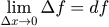 . Clearly then the equation does not hold for non-zero Δx.
Given a multivariate function f(x, y, z), the total differential is expressed as df = fxdx + fydy + fzdz where...
fx = ∂f/∂x
fy = ∂f/∂y
fz = ∂f/∂z
Beyond approximation, differentials also provide a framework for relating change. If the above function f were parameterized in terms of time t, then the equation can be divided by dt to give:
