
|
Size: 756
Comment: Initial commit
|
Size: 1010
Comment: Replacing with SVGs
|
| Deletions are marked like this. | Additions are marked like this. |
| Line 21: | Line 21: |
| The double [[Calculus/ComplexNumbers#Complex_Conjugate|conjugate]] of a vector is the original vector: ''a̿ = a''. | The double [[Calculus/ComplexNumbers#Complex_Conjugates|conjugate]] of a vector is the original vector: ''a̿ = a''. |
| Line 24: | Line 24: |
| * If ''c = ab'', then ''c̅ = a̅b̅''. * If ''c = a + b'', then ''c̅ = a̅ + b̅''. * If ''c = a - b'', then ''c̅ = a̅ - b̅''. * If ''d = exp(a)'', then ''d̅ = exp(a̅)'' * If ''d = ln(a)'', then ''d̅ = ln(a̅)'' |
* {{attachment:dist1.svg}} * {{attachment:dist2.svg}} |
| Line 34: | Line 31: |
| Note that a complex vector as ''z = [1+i 1-i]'' would, according to the conventional definition for [[Calculus/Distance|distance]], have a magnitude of 0. Only the zero vector should have a magnitude of 0 however. Distance of complex vectors relies on [[Calculus/ComplexNumbers#Complex_Conjugate|conjugation]]. In [[LinearAlgebra|linear algebra]] notation, the distance of complex vector ''z'' is equal to ''z̅^T^z''. |
Complex Vector
A complex vector is a vector whose members are complex numbers.
Contents
Description
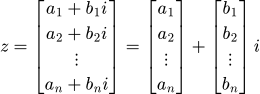
A complex vector is simply a vector of complex numbers.
Properties
The double conjugate of a vector is the original vector: a̿ = a.
Conjugation is distributive.


Distance
Note that a complex vector as z = [1+i 1-i] would, according to the conventional definition for distance, have a magnitude of 0. Only the zero vector should have a magnitude of 0 however.
Distance of complex vectors relies on conjugation. In linear algebra notation, the distance of complex vector z is equal to z̅Tz.