
|
Size: 1397
Comment: More detail
|
← Revision 7 as of 2025-10-16 20:27:40 ⇥
Size: 2124
Comment: More rewritten
|
| Deletions are marked like this. | Additions are marked like this. |
| Line 3: | Line 3: |
| The '''chain rule''' is an approach for differentiating a composition of functions in terms of those functions. | The '''chain rule''' is an approach for [[Calculus/Derivative|differentiating]] a composition of functions. |
| Line 11: | Line 11: |
| == Notation == | == Description == |
| Line 13: | Line 13: |
| The common notation for the chain rule is, given a function ''h(x) = f(g(x))'', the derivative ''h'(x) = f'(g(x)) g'(x)''. | Given a function defined like ''f(x) = g(h(x))'', the derivative of ''f'' is ''g'(h(x)) h'(x)''. |
| Line 15: | Line 15: |
| An equivalent notations is that ''h = f ∘ g'' and ''h' = (f ∘ g)' = (f' ∘ g)g' ''. | Sometimes this is notated as ''f = g ∘ h'' and ''f' = (g' ∘ h)h' ''. |
| Line 17: | Line 17: |
| A parallel notation is: | Equivalently, consider: |
| Line 19: | Line 19: |
| {{attachment:leibniz.svg}} | {{attachment:notation1.svg}} {{attachment:notation2.svg}} === Multivariate === A notation for [[Calculus/PartialDerivative|partial derivatives]] will be used such that ''a,,b,, = ∂a/∂b''. Given a multivariate composition like ''f(g,h)'' where ''g = g(x,y)'' and ''h = h(x,y)'', the [[Calculus/Differential|total differential]] demonstrates that: ''df = f,,g,,dg + f,,h,,dh'' ''df = f,,g,,(g,,x,,dx + g,,y,,dy) + f,,h,,(h,,x,,dx + h,,y,,dy)'' ''df = f,,g,,g,,x,,dx + f,,g,,g,,y,,dy + f,,h,,h,,x,,dx + f,,h,,h,,y,,dy'' ''df = (f,,g,,g,,x,, + f,,h,,h,,x,,)dx + (f,,g,,g,,y,, + f,,h,,h,,y,,)dy'' Clearly then ''f,,g,,g,,x,, + f,,h,,h,,x,, = f,,x,,'' and ''f,,g,,g,,y,, + f,,h,,h,,y,, = f,,y,,''. Equivalently, consider: {{attachment:notation3.svg}} |
| Line 47: | Line 69: |
| Several of these terms are trivial to derive. The derivative of ''e'' to an exponent is itself, so the derivative of ''P'' with respect to ''v'' is ''P''. The derivative of a natural logarithm of some variable is 1 over that variable, so the derivative of ''u'' with respect to ''Q'' is ''1/Q''. This leaves the equation as: | Several of these terms are trivial to derive. The derivative of ''e'' to an exponent is itself, so the derivative of ''P = e^v^'' with respect to ''v'' is ''P''. The derivative of a natural logarithm of some variable is 1 over that variable, so the derivative of ''u = ln Q'' with respect to ''Q'' is ''1/Q''. This leaves the equation as: |
Chain Rule
The chain rule is an approach for differentiating a composition of functions.
Contents
Description
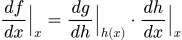
Given a function defined like f(x) = g(h(x)), the derivative of f is g'(h(x)) h'(x).
Sometimes this is notated as f = g ∘ h and f' = (g' ∘ h)h' .
Equivalently, consider:

Multivariate
A notation for partial derivatives will be used such that ab = ∂a/∂b.
Given a multivariate composition like f(g,h) where g = g(x,y) and h = h(x,y), the total differential demonstrates that:
df = fgdg + fhdh
df = fg(gxdx + gydy) + fh(hxdx + hydy)
df = fggxdx + fggydy + fhhxdx + fhhydy
df = (fggx + fhhx)dx + (fggy + fhhy)dy
Clearly then fggx + fhhx = fx and fggy + fhhy = fy. Equivalently, consider:

Usage
Point elasticity is defined as:

It can be simplified using the chain rule into:

Start with the final formulation and use u- and v-substitution:

Note in particular that the equation for v can be rewritten in terms of P:

Now the final formulation can be rewritten as:

Several of these terms are trivial to derive. The derivative of e to an exponent is itself, so the derivative of P = ev with respect to v is P. The derivative of a natural logarithm of some variable is 1 over that variable, so the derivative of u = ln Q with respect to Q is 1/Q. This leaves the equation as:
