
|
Size: 691
Comment: Example
|
← Revision 7 as of 2025-10-16 20:27:40 ⇥
Size: 2124
Comment: More rewritten
|
| Deletions are marked like this. | Additions are marked like this. |
| Line 3: | Line 3: |
| The '''chain rule''' is an approach for differentiating a composition of functions in terms of those functions. | The '''chain rule''' is an approach for [[Calculus/Derivative|differentiating]] a composition of functions. |
| Line 11: | Line 11: |
| == Notation == | == Description == |
| Line 13: | Line 13: |
| The common notation for the chain rule is, given a function ''h(x) = f(g(x))'', the derivative ''h'(x) = f'(g(x)) g'(x)''. | Given a function defined like ''f(x) = g(h(x))'', the derivative of ''f'' is ''g'(h(x)) h'(x)''. |
| Line 15: | Line 15: |
| An equivalent notations is that ''h = f ∘ g'' and ''h' = (f ∘ g)' = (f' ∘ g)g' ''. | Sometimes this is notated as ''f = g ∘ h'' and ''f' = (g' ∘ h)h' ''. |
| Line 17: | Line 17: |
| A parallel notation is: | Equivalently, consider: |
| Line 19: | Line 19: |
| {{attachment:leibniz.svg}} | {{attachment:notation1.svg}} {{attachment:notation2.svg}} === Multivariate === A notation for [[Calculus/PartialDerivative|partial derivatives]] will be used such that ''a,,b,, = ∂a/∂b''. Given a multivariate composition like ''f(g,h)'' where ''g = g(x,y)'' and ''h = h(x,y)'', the [[Calculus/Differential|total differential]] demonstrates that: ''df = f,,g,,dg + f,,h,,dh'' ''df = f,,g,,(g,,x,,dx + g,,y,,dy) + f,,h,,(h,,x,,dx + h,,y,,dy)'' ''df = f,,g,,g,,x,,dx + f,,g,,g,,y,,dy + f,,h,,h,,x,,dx + f,,h,,h,,y,,dy'' ''df = (f,,g,,g,,x,, + f,,h,,h,,x,,)dx + (f,,g,,g,,y,, + f,,h,,h,,y,,)dy'' Clearly then ''f,,g,,g,,x,, + f,,h,,h,,x,, = f,,x,,'' and ''f,,g,,g,,y,, + f,,h,,h,,y,, = f,,y,,''. Equivalently, consider: {{attachment:notation3.svg}} |
| Line 27: | Line 49: |
| [[Economics/DemandCurve#Point_Elasticity|Point elasticity]] can be differentiated with the chain rule: | [[Economics/DemandCurve#Point_Elasticity|Point elasticity]] is defined as: |
| Line 31: | Line 53: |
| It can be simplified using the chain rule into: |
|
| Line 32: | Line 56: |
Start with the final formulation and use ''u''- and ''v''-substitution: {{attachment:substitution1.svg}} Note in particular that the equation for ''v'' can be rewritten in terms of ''P'': {{attachment:substitution2.svg}} Now the final formulation can be rewritten as: {{attachment:substitution3.svg}} Several of these terms are trivial to derive. The derivative of ''e'' to an exponent is itself, so the derivative of ''P = e^v^'' with respect to ''v'' is ''P''. The derivative of a natural logarithm of some variable is 1 over that variable, so the derivative of ''u = ln Q'' with respect to ''Q'' is ''1/Q''. This leaves the equation as: {{attachment:substitution4.svg}} |
Chain Rule
The chain rule is an approach for differentiating a composition of functions.
Contents
Description
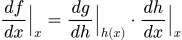
Given a function defined like f(x) = g(h(x)), the derivative of f is g'(h(x)) h'(x).
Sometimes this is notated as f = g ∘ h and f' = (g' ∘ h)h' .
Equivalently, consider:

Multivariate
A notation for partial derivatives will be used such that ab = ∂a/∂b.
Given a multivariate composition like f(g,h) where g = g(x,y) and h = h(x,y), the total differential demonstrates that:
df = fgdg + fhdh
df = fg(gxdx + gydy) + fh(hxdx + hydy)
df = fggxdx + fggydy + fhhxdx + fhhydy
df = (fggx + fhhx)dx + (fggy + fhhy)dy
Clearly then fggx + fhhx = fx and fggy + fhhy = fy. Equivalently, consider:

Usage
Point elasticity is defined as:

It can be simplified using the chain rule into:

Start with the final formulation and use u- and v-substitution:

Note in particular that the equation for v can be rewritten in terms of P:

Now the final formulation can be rewritten as:

Several of these terms are trivial to derive. The derivative of e to an exponent is itself, so the derivative of P = ev with respect to v is P. The derivative of a natural logarithm of some variable is 1 over that variable, so the derivative of u = ln Q with respect to Q is 1/Q. This leaves the equation as:
