Outer Measure
An outer measure is a map that provides a concept of size to sets.
Description
For a given set X, an outer measure is a map μ* : P(X) -> [0,∞] (i.e., a map from all subsets of the given set to non-negative real numbers). Note that [0,∞] is shorthand for the more formally correct [0,∞) ∪ {∞}.
The concept follows from covers, i.e. a countable union of open sets defined as covering some other reference set. If these covers can be ordered then there is an infimum cover; the size of this is the size of the set. The ordering is achieved with a monotonic, non-negative function p that maps a set to a real number, and always maps the empty set (Ø) to zero. For example, a function that maps the empty set (Ø) to zero and all other sets to 1.
More generically, an outer measure must satisfy three conditions:
μ*(Ø) = 0
if A ⊂ B ⊂ X then μ*(A) ≤ μ*(B)
σ sub-additivity: sub-additivity for finite and countably infinite elements, but not infinite elements
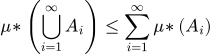
- There is no requirement for disjoint sets because clearly the union of two intersecting sets is smaller than the sum of those sets considered separately.
Lebesgue Outer Measure
One example is the Lebesgue outer measure, sometimes specially denoted as λ*.
In R, the conventional measure μ for length of an interval (a,b) (or equivalently [a,b]) is b - a. Let intervals be notated I = (a, b), or Ii = (ai, bi) when there are many such intervals. The outer measure of A in R is defined by the intervals Ii that cover it. More specifically, it is defined by the infimum of all possible such intervals.

In higher dimensions, i.e. Rn, the conventional measure is expressed as a Cartesian product of intervals: I1 x I2 x ... x In = (a1, b1) x (a2, b2) x ... x (an, bn). Denote this Cartesian product as C, or Ci when there are many. The conventional measure μ is calculated as μ(C) = (b1 - a1) x (b2 - a2) x ... x (bn - an). The Lebesgue outer measure for Rn follows in the same way from here.