
|
Size: 975
Comment: Initial commit
|
Size: 1725
Comment: Moving to analysis
|
| Deletions are marked like this. | Additions are marked like this. |
| Line 1: | Line 1: |
| ## page was renamed from Statistics/NormalDistribution | |
| Line 3: | Line 4: |
| The '''normal distribution''' is a bell-shaped continuous probability distribution that is parameterized to a mean and standard deviation. | The '''normal distribution''' is a bell-shaped continuous probability distribution function that is parameterized to a mean and standard deviation. |
| Line 13: | Line 14: |
| The distribution is bell-shaped. | The distribution is bell-shaped and parameterized to the [[Statistics/Moments|first and second moments]]. This has useful consequences for estimating the probability that a given value is in the distribution. For example: |
| Line 17: | Line 19: |
A variable distributed this way is notated (especially in [[Statistics/EconometricsNotation|econometrics]]) like X ~ N(μ, σ^2^). When the mean is 0 and the [[Statistics/Variance|variance]] is 1, the p.d.f. is specifically referred to as the '''standard normal distribution'''. This is defined as {{attachment:stdnorm.svg}}. {{attachment:stdnormgraph.png||width=300px}} More generally, the p.d.f. is given by ''f(x) = (1/σ) * φ(x-μ/σ)''. The c.d.f. for the standard normal distribution is notated as ''Φ(.)'', while the c.d.f. for the generic normal distribution is sometimes notated as ''F(.)''. |
|
| Line 22: | Line 34: |
| == Statistics == | == Moments == |
| Line 24: | Line 36: |
| The mean and standard deviation are necessarily given by the distribution formulation. | The [[Statistics/Moments|first and second moments]] are intrinsic to the distribution definition. |
| Line 34: | Line 46: |
| === Standard Normal Distribution === | === Probability Tests === |
| Line 36: | Line 48: |
| The normal distribution characterized by a mean of 0 and a standard deviation of 1 is called the '''standard normal distribution'''. This distribution is referenced for '''Z scores''' (alternatively called '''Z statistics'''). As an example, for a two-tailed test and a [[Statistics/TestStatistic|significance level]] of 5%, the critical Z score value is 1.96. |
The standard normal distribution is referenced for '''Z scores''' (alternatively called '''Z statistics'''). As an example, for a two-tailed test and a [[Statistics/TestStatistic|significance level]] of 5%, the critical Z score value is 1.96. |
Normal Distribution
The normal distribution is a bell-shaped continuous probability distribution function that is parameterized to a mean and standard deviation.
Description
The distribution is bell-shaped and parameterized to the first and second moments. This has useful consequences for estimating the probability that a given value is in the distribution. For example:
- 68.27% of the cumulative distribution is within 1 standard deviation of the mean
- 95.45% within 2
- 99.73% within 3
A variable distributed this way is notated (especially in econometrics) like X ~ N(μ, σ2).
When the mean is 0 and the variance is 1, the p.d.f. is specifically referred to as the standard normal distribution. This is defined as 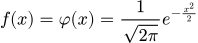 .
.

More generally, the p.d.f. is given by f(x) = (1/σ) * φ(x-μ/σ).
The c.d.f. for the standard normal distribution is notated as Φ(.), while the c.d.f. for the generic normal distribution is sometimes notated as F(.).
Moments
The first and second moments are intrinsic to the distribution definition.
Usage
Probability Tests
The standard normal distribution is referenced for Z scores (alternatively called Z statistics). As an example, for a two-tailed test and a significance level of 5%, the critical Z score value is 1.96.