Binomial Theorem
The binomial theorem is a method for expanding binomial expression.
Contents
Description
Consider the binomial expression (a + b)n. It expands to a sum of terms that are all of the form an-kbk. (Or equivalently, akbn-k.) There are always n+1 different forms of terms in the expression.
The number of terms that are of the form an-kbk for a specific value of k is given by a combination. For example, consider (a + b)2; the number of terms that are of the form a0b2 = b2 is 1.

The number of terms that are of the form a2b0 = a2 is also 1.

(It should be apparent that an-kbk and akbn-k are still equivalent.)
More generally, for a specific value of k, the number of terms in the expansion of (a + b)n that are of the form an-kbk is given by:
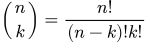
(And the equivalence of an-kbk and akbn-k is now proven generally by Pascal's rule.)
The original binomial expression (a + b)n can therefore be solved as a sum over all values of k from zero to n.
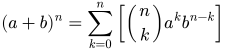
The number of terms of a specific form is a binomial coefficient.
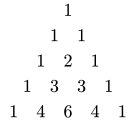
Pascal's Triangle
Pascal's triangle is formed by rows of binomial coefficients; the nth row (starting at 0) is composed of the binomial coefficients for the binomial expression.
Consider:
(a+b)0 = (1)
(a+b)1 = (1)a + (1)b
(a+b)2 = (1)a2 + (2)ab + (1)b2
(a+b)3 = (1)a3 + (3)a2b + (3)ab2 + (1)b3
And compare this to: